Bird song classifiers for Zürcher Oberland forests and at the Luppmen, plus quiz
Decision table for identifying birdsong
Übung
| Bird | Description | Audio |
| einfach rhythmisch | ||
 Kohlmeise llhllh ■■
 |
einfach rhythmisch slow medium (1-5 KHz) .
Said to have a repertoire as a species of 50 or more different songs, albeit simple ones, up to 10 per individual.
Females prefer a male with a large repertoire. One two-note song sounds like a squeaky bed.
Song: Nabu: Die erste Vogelart, die wir im Jahr hören, ist meistens die Kohlmeise mit ihrem typischen Läuten: "Zip Zäh" oder "Zip zip Zäh". [NABU Experte Lars Lachmann bei Deutschlandfunk Nova] Song highly variable, but usually consisting of two to three notes repeated in a motif. Same birds have many different motifs but generally repeat them many times before switching. Identified by its timbre and often metallic resonant quality, more than by actual phrasing (which is very variable). Often includes buzzing sounds in song. [Link] Song highly variable, but usually consisting of two to three notes repeated in a motif. Same birds have many different motifs but generally repeat them many times before switching. Identified by its timbre and often metallic resonant quality, more than by actual phrasing (which is very variable). Often includes buzzing sounds in song. [Link] | ♫ |
| Triller | ||
 Blaumeise h ll ■■
 |
Triller einfach rhythmisch slow high (3-9 KHz) .
General: High-pitched, often descending (hhll), occasionally ascending. "Christina compares it to a ping-pong ball dropping. [In Januar singt die Kohlmeise als erster Vogel in Deutschland], dann kommt die Blaumeise dazu. Song: Song: Characteristic, clear, high-pitched, vibrating call. Usually introduced by a couple of accenting syllables, followed by ringing vibrating notes: "ti ti chuhuhuhuhuhuhuhuhuhu". [Link] | ♫ |
 Sumpfmeise 1-Noter, Sumpf laenger als Kohl hhmmlll ■■
 |
einfach rhythmisch fast low-high (2-10 KHz) .
General: Higher-pitched than great tit, sometimes repetitive 1- and 2-note tunes like them, sometimes simple melodies, usually pure, sometimes chirpy or raspy. Song: 'Song: A simple one or two note call repeated in series. Usually rising slightly in pitch, and with a "liquid" quality.'. [Link] At bird-song.ch it's hl-rest-hl, or 7-8 2-noter swoops. bird-song.ch names lh-break-hl as a pistjä call and also has a series of 7 or 8 falling 'swoops'. [Link]
Song: Klapperlied - 6-8 Noten 'angeschlagen' At bird-song.ch it's hl-rest-hl, or 7-8 2-noter swoops. bird-song.ch names lh-break-hl as a pistjä call and also has a series of 7 or 8 falling 'swoops'. [Link]
Song: Klapperlied - 6-8 Noten 'angeschlagen' Klapperlied. Reihe (6-8) weich angeschlagene Töne mittlerer Höhe. Ähnlich der Klappergrasmücke aber weicher. (Sumpf ist weich) Oft auch Rufe wie „psja“ zu hören. Ziemlich scharf u. gepresst. [Link] Klapperlied. Reihe (6-8) weich angeschlagene Töne mittlerer Höhe. Ähnlich der Klappergrasmücke aber weicher. (Sumpf ist weich) Oft auch Rufe wie „psja“ zu hören. Ziemlich scharf u. gepresst. [Link] |
♫

|
| stereotypisch melodisch | ||
 Heckenbraunelle ■■
 |
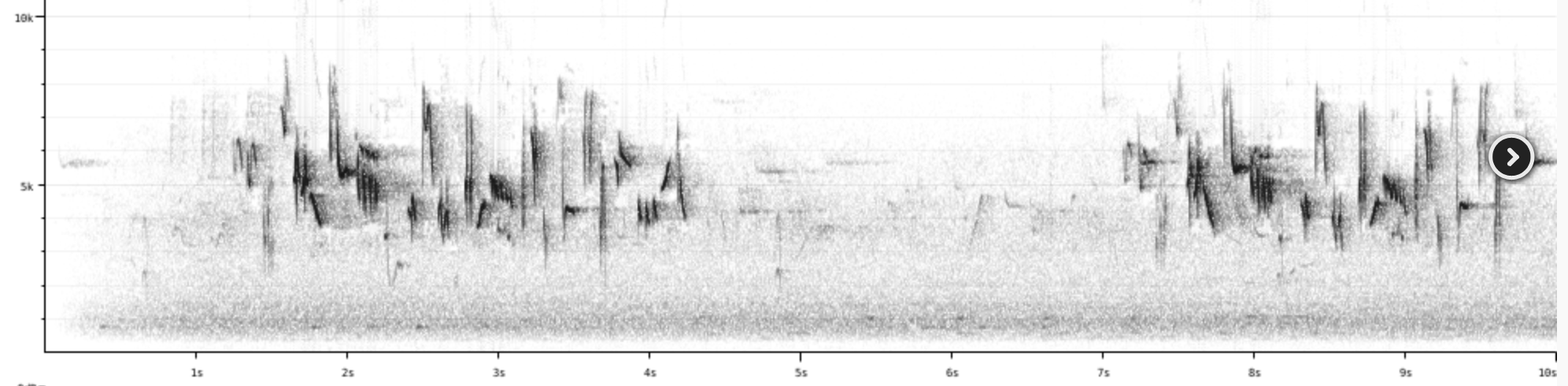
stereotypisch melodisch fast high (4-8 KHz) .
General: High-pitched, repetitive but complex little tune, 3 seconds long with about 15 notes rising and falling, falling at the end, then 3 second pause. Song:  Melodisch, slowly rising, roughly like black-cap warbler, which I guessed in the bird-song.ch quiz. [Link]Schnell wie ein Rotkehlchen aber nicht herunter plätschernd, hoch und runter zwischen 3 und 7 kHz. [Link]
Song: Singt schon im Vorfrühling. Klangfarbe ähnlich Gartenbaumläufer. Aufbau ähnlich Zaunkönig, aber ohne Triller. Viel leiser und dünner.
[Link]Song a fast and evenly paced, high pitched stream of clear notes. No consistent phrasing. Similar in timbre to Robin, but does not vary tempo or pitch nearly as much. Often compared to the sound of a squeaky wheelbarrow. [Link] Melodisch, slowly rising, roughly like black-cap warbler, which I guessed in the bird-song.ch quiz. [Link]Schnell wie ein Rotkehlchen aber nicht herunter plätschernd, hoch und runter zwischen 3 und 7 kHz. [Link]
Song: Singt schon im Vorfrühling. Klangfarbe ähnlich Gartenbaumläufer. Aufbau ähnlich Zaunkönig, aber ohne Triller. Viel leiser und dünner.
[Link]Song a fast and evenly paced, high pitched stream of clear notes. No consistent phrasing. Similar in timbre to Robin, but does not vary tempo or pitch nearly as much. Often compared to the sound of a squeaky wheelbarrow. [Link] |
♫
|
| improvisiert melodisch | ||
| flöten | ||
 Rotkehlchen ■■
 |
flöten improvisiert melodisch fast high (3-9 KHz) .
General: Hoch aber auch bis tief, z.B. 2.9-7.7 KHz.
Wikipedia sagt, 'Der Gesang des Rotkehlchens ist mit 275 nachgewiesenen,
sich fortlaufend ändernden Motiven äußerst variabel.
[Ein einzelner Vogel lernt teilweise mehr als 30 verschiedene Strophen, sagteChristina Ebneter in BirdLife Feldornithologie-Kurs.]
Er wird mit vorgestreckter, das Rot betonender Brust, in der Regel von einer hohen Singwarte aus, vorgetragen. Er beginnt etwa eine Stunde vor Sonnenaufgang und ist noch eine gute Zeit nach Sonnenuntergang zu hören, hauptsächlich jedoch während der Dämmerung. Der Revieranzeigegesang wird normalerweise mit perlenden reinen Tönen und Trillern eingeleitet und fällt gegen Ende langsam ab; hohe metallische Töne werden oft dazwischen eingeschoben. Häufig sind in die 2,5 Sekunden langen Strophen auch undeutliche Imitationsphrasen eingelegt. Auf den Menschen wirkt der Reviergesang lieblich und schwermütig melodiös. Ist das Rotkehlchen hochgradig erregt, verdeutlicht es seinen Willen zur Eskalation durch übertönendes oder störendes Singen.' Ich habe in Ticino und Falera festgestellt, dass die Rotkehlchen immer noch singen und habe es nachher auch daheim im Zürcher Oberland gehört; das Ende des Singen Ende Juli ist anscheinend relativ. Seitdem weiss ich dass es eine der wenigen Vogelarten ist, die auch in Winter ein Territorium verteidigt...darum. Song:  Only for a short period in late summer while they are moulting and inconspicuous do robins stop singing. Both sexes sing. [RSPB article]
Song: Song medium to very high pitched, with mostly clear tones with a liquid quality. Timbre reminiscent of Wren or Dunnock, but with a much more varied structure and tempo. Pitch ranges from very high to low, almost thrush-like, notes. No recognizable motifs. Often ends on a rising or falling pitch, giving it a "Chinese" accent. [Link] Only for a short period in late summer while they are moulting and inconspicuous do robins stop singing. Both sexes sing. [RSPB article]
Song: Song medium to very high pitched, with mostly clear tones with a liquid quality. Timbre reminiscent of Wren or Dunnock, but with a much more varied structure and tempo. Pitch ranges from very high to low, almost thrush-like, notes. No recognizable motifs. Often ends on a rising or falling pitch, giving it a "Chinese" accent. [Link] |
♫

|
| Triller | ||
 Zaunkönig ■■
 |
Triller improvisiert melodisch fast high (3-9 KHz) .
High-pitched, melodic, very variable with many trills and whistles. At least 3 seconds long, switching low to high 6 times or more, always a trill in the mix. Der deutsche Kalendar für 2025 sagt, sie könnten ab Drei-Königs-Tag singen, d.h. ab 6. Januar. nabu.de sagt ab 1. Februar, Drei-Königs-Tag ist eventuell nur wegen dem Namen Zaunkönig? Song: Auffällig laut für den kleinen Vogel. Singt auch im Winter! Schmetternd, mit einem bis zwei Trillern als letztes oder vorletztes Glied.
[Link]Song surprisingly loud. A high-pitched stream of clear notes resembling Robin and Dunnock in timbre. Differs from those in showing frequent shifts in pitch with much larger register than Dunnock, and by the unique, numerous, interspersed long trills. [Link] |
♫

|
| stereotypisch melodisch | ||
| churr | ||
 Hausrotschwanz ■■
 |
churr stereotypisch melodisch slow high (3-9 KHz) .
The song is two parts and unvarying. If it were a pop song, you'd call it ABABAB... The second part starts with a
sputtering trill. The RSPB in the UK says 'warble with crackling trills.' Vogelwarte.ch says
'Der gepresst knirschende Gesang setzt meist lange vor Sonnenaufgang ein und ist der Auftakt für das Vogelkonzert.'
BirdLife-Zuerich.ch says 'Einziger Sänger morgens um drei in den Häuserschluchten'.
Obwohl NABU.de meint, sie singen nicht mehr nach Juli, war ich angenehm überrascht sie in Oktober im Tessin zu hören.
Song: Other: Einige Arten wie der Hausrotschwanz singen zudem im Herbst, bevor sie in ihr Winterquartier ziehen. Die Männchen legen dann ihre Reviere bereits «provisorisch» fest. [Link]Am Morgen der erste Sänger: Kurzes dreiteiliges Liedchen, meist von Warte aus gesungen. Mittelstück aus rauen gequetschten Tönen. (als ob kurz die Stimme verloren)
[Link]Song consists of three parts and is distinct if heard well. It opens with some clear notes that may form a trill, which are then followed by a pause. The "gravel-part" does not carry as far as the rest of the song. [Link] |
♫

|
| improvisiert melodisch | ||
| absteigend | ||
 Singdrossel mhHL ■■
 |
absteigend improvisiert melodisch slow low-high (2-9 KHz) .
Paced like a blackbird, humorous mix of elements like a nightingale. Huge range, elements from 2-5 KHz, others 6.5-9 KHz. Can sing for up to 50 minutes, and a male may know 100 melodies in its repertoire.
Song: Klangfarbe ähnlich obiger Art [Amsel], aber jedes Element 2-4mal wiederholt, Pausen zwischen den Phrasen.(klingt oft wie „Philipp“, oder „Judith“) Einzige Drossel unseres Gebietes die diese Wiederholungen macht. Singt oft nicht von Baumspitze aus, sondern aus dem Geäst.
[Link] | ♫ |
| nicht musikalisch | ||
| rasseln | ||
 Misteldrossel ■■
 |
rasseln nicht musikalisch fast low-high (2-9 KHz) .
Song: Die Stimme ist ähnlich wie die vom Pirol. [Link]Gesang ähnlich Amsel, aber eintöniger mit geringerem Tonumfang [auch kürzer, kein schnirpsliges Ende -- Bill] [Link]
Song: Gesang ähnlich dem der Amsel, aber weniger abwechslungsreich und melancholisch, fast weinerlich klingend. Meist von Tannenspitze aus.
[Link]Song loud, far reaching and melodic. Most similar to Blackbird, but pitch is higher, phrases shorter (3-6 notes) and most notably, pauses between phrases are much shorter. All which gives the song a much more hurried feel than that of the Blackbird. Timbre is thinner and slightly shivering, and tonal range more limited. May have recurring favourite motifs, but does not repeat phrases like Song Thrush. Sometimes adds higher pitched parts and imitations. [Link] |
♫

|
| stereotypisch melodisch | ||
 Rotdrossel down 6+chattering ■■
 |
stereotypisch melodisch slow medium (3-5 KHz) .
Song delivered in two parts. First a simple, melodic phrase of 3 - 6 notes, usually followed by a more silent, indistinct, fast and less melodic, chattering sequence. First part highly variable from place to place, but constant in individuals. [Link]
Song: Song delivered in two parts. [Link] |
♫

|
| einfach rhythmisch | ||
 Zilpzalp ■■
 |
einfach rhythmisch slow high (3-9 KHz) .
Seems to consist of 3 notes repeated randomly, occasionally just 2 notes.
Though NABU.de says they stop singing at the end of July, I do hear their 3-note song occasionally in October,
but just one or two repetitions.
Song: Von Mitte August bis Ende September bringt der Zilpzalp regelmäßig Herbstgesang dar. [Link]Lange Reihen (6-20) von „zilp-zalp“-Rufen, meist abwechselnd in Tonhöhe. (Als bemühe sich der Sänger vergeblich den ersten Ton wieder zu treffen , ohne jedoch weit zu verfehlen.) „Zins zahl, Zins zahl, zahl Zins, Zins Zins zahl“ („Zins“ etwas höher als „zahl“) [Link]Song a very distinct: "chiff-chaff-chiff-chiff-chaff-chiff", in a regular clock-like rhythm. Each syllable at seemingly random pitch, but no large intervals tonally. Sometimes "get stuck" at one note. [Link] | ♫ |
| stereotypisch melodisch | ||
 XXXX Bei Wildert glaube ich dass das ein Fitis ist und kein Zilp-zalp aber MerlinBirdId war auch verwirrt und hat ZZ besser gefunden.JPG) Fitis Buchfink diva ■■
Fitis Buchfink diva ■■ |
stereotypisch melodisch fast high (3-9 KHz) .
Gesang wie Buchfink aber höher, schnell, tendenz fallend aber mit mehr hoch und runter.
Song: Reihe v. Pfeiflauten (ca 12) etwas abfallend. Klingt ähnlich Buchfink, aber etwas traurig, melancholisch, wie in moll-Tonart. [Link]By far most easily identified by it's call or song. Song: A 3-5 second, falling phrase of soft, rippling "svi-svi" sounds, starting high with some attack, and then falling in a mellow manner. The phrase lacks any conclusion, and diminishes both in strength and tempo. [Link] |
♫

|
| improvisiert melodisch | ||
| Mimikry | ||
 Mönchsgrasmücke hml ■■
 |
Mimikry improvisiert melodisch fast medium (2-5 KHz) .
They sometimes sing like a blackbird on speed - also non-stereotypic, seemingly improvised,
in short bursts.
Our local guy ends most of his songs with the same seven notes, which I find a good way to confirm the identification. In Ticino we often heard the 'Leiern' sound - the warblers would sing just the first 3 notes of a longer song, then stop. The order varied; high-medium-low I call 'Figaro' as in the opera, low-high-medium 'whiskey bar', as it sounded to me like the Kurt Weill lyrics, 'O-oh-show me-the-way to-the-next whis-ke-bar' - but the warbler usually stopped after 'way' or 'next' The British authors of The Sound Approach claim to hear 'a warblel and a whistle'.
Song: Mit schwätzendem Vorgesang, (kann auch kurz sein oder ganz fehlen) der dann in klare, kräftige, zum Ende hin in wehmütige Flötentöne übergeht (Überschlag)
[Link]Song pleasing, varied and loud. Sometimes very similar to Garden Warbler. A typical phrase starts with soft, staccato chattering and mimicry, which after a few seconds changes to a much louder, pure and resonant stream of notes for about 3-5 seconds. No fixed motif, but may end phrases with recurring notes. Often deviates from the characteristic type of song, and identification from song alone may be impossible. May sing first part of song for extended periods without ever reaching the characteristic ending. [Link] | ♫ |
| stereotypisch melodisch | ||
 Wintergoldhähnchen W=Winter=v.a. runter, dann wieder hoch, plus melodischer Schluss ■■
 |
stereotypisch melodisch slow high (6-8 KHz) .
 Vogelwarte.ch sagt, sehr hoher Gesang leicht auf- und absteigend. Hier fängt es mit flach an. [Link]
Song: Kurze Reihe von sehr hohen, leisen Tönen in auf-absteigender Tonhöhe, an das „W“-im Namen erinnernd. [Link]Song: a very high-pitched, undulating series of arpeggiated notes moving down and up again, repeated 4-5 times ending with a marked "conclusion" (like "trying to start a tiny motor and failing"). Timbre of song similar to contact call. [Link] Vogelwarte.ch sagt, sehr hoher Gesang leicht auf- und absteigend. Hier fängt es mit flach an. [Link]
Song: Kurze Reihe von sehr hohen, leisen Tönen in auf-absteigender Tonhöhe, an das „W“-im Namen erinnernd. [Link]Song: a very high-pitched, undulating series of arpeggiated notes moving down and up again, repeated 4-5 times ending with a marked "conclusion" (like "trying to start a tiny motor and failing"). Timbre of song similar to contact call. [Link] |
♫

|
| einfach rhythmisch | ||
 weiblich.jpg) Sommergoldhähnchen Noten vom 'Sommer' steigen wie die Temperaturen ■■
Sommergoldhähnchen Noten vom 'Sommer' steigen wie die Temperaturen ■■ |
einfach rhythmisch fast high (6-8 KHz) .
Very high rhythmic repetition of about 3 seconds
Song: Wie [beim Wintergoldhähnchen] aber auf gleicher Tonhöhe bleibend. [Link]Song: Similar in timbre to Goldcrest, but much more monotonous. [Link] |
♫

|
 Grauschnäpper ■■
 |
einfach rhythmisch slow high (6-8 KHz) .
High (6-8 KHz?) short sound repeated every half to 5 seconds.
Song: Gesang 'unauffällig' - zirp x 2-3, mal steigender tWITSong a primitive, slow series of various buzzing and very high pitched sounds. No recurring phrases. [Link] |
♫

|
| einnotig | ||
 Kleiber 6x steigt, wie 6-Buchstaben 'Kleber' ll ■■
 |
einnotig fast medium (1-5 KHz) .
Song: Song a simple series of loud notes [Link]
Song: Other: The song is very variable, with rising and falling notes, sometimes with repetition of excitement calls. [Link] The song is a slow whistled pee-pee-pee with many variants, including a faster version, and may be intermingled with the call. [Link] The song is a slow whistled pee-pee-pee with many variants, including a faster version, and may be intermingled with the call. [Link]Other: Song a simple series of loud notes. [Link] Song a simple series of loud notes. [Link] |
♫

|
| stereotypisch melodisch | ||
 Gartenbaumläufer 'Gar-ten-baum-LÄU-FER' mlLh ■■
 |
stereotypisch melodisch slow high (4-7 KHz) .
It sounds to me like a 5-7 note song like 'five k low high higher', 'short song in the gar-DEN'. The individual notes have the same backward checkmark shape as the call. It's basically the same across Europe.The song of the nominate subspecies is an evenly spaced sequence of notes teet-teet-teet-e-roi-tiit. [Link]Its song is short, loud and rhythmic. [Link] [In comparison with the visually similar Eurasian treecreeper, it] has a clearer, louder more staccato contact call of ‘sreet’ or ‘sree’ and a short ‘wit’ during normal activity [Link]
Song: Kurz u. bündig! (Gartenwege sind kurz.) Tonreihe am Schluss ansteigend. „Hesch du gseh woni bi?
[Link]Song diagnostic, and introductory notes often used singly when interacting. Full song starts with one or two staccato introductory notes, the first higher pitched than the second, followed by a rapid, ascending crescendo ending in a drawn-out, less pure "sree". The tone is loud and much more penetrating and clear than C. familiaris. [Link] [In comparison with the visually similar Eurasian treecreeper, it] has a clearer, louder more staccato contact call of ‘sreet’ or ‘sree’ and a short ‘wit’ during normal activity [Link]
Song: Kurz u. bündig! (Gartenwege sind kurz.) Tonreihe am Schluss ansteigend. „Hesch du gseh woni bi?
[Link]Song diagnostic, and introductory notes often used singly when interacting. Full song starts with one or two staccato introductory notes, the first higher pitched than the second, followed by a rapid, ascending crescendo ending in a drawn-out, less pure "sree". The tone is loud and much more penetrating and clear than C. familiaris. [Link] |
♫

|
 Waldbaumläufer Waldwege sind lang ■■
 |
stereotypisch melodisch slow medium (1-5 KHz) .
Ich sage: es klingt wie ein schneller, hoher Buchfink. Wikipedia sagt: Die kurze Gesangsstrophe ist eine abfallende, zum Ende wieder ansteigende Reihe von leisen Pfeiftönen und erinnert an die Lautäußerungen von Blaumeise und Fitis. The example at bird-song.ch is a series of 5 notes falling 3x and rising back 2x, then 5 or so fast falling notes.
Song: Lang u. klar! (Waldwege sind lang). Tonreihe im Ganzen absinkend, nur letzter Ton höher. [Link]Song a short, continuous three-part phrase. [Link] |
♫

|
 Schwanzmeise Diddly doot-doot-doot-doot hhmll ■■
 |
stereotypisch melodisch slow high (3-9 KHz) .
General: Meistens hört man das Pfief...chk..chk..Pfief von den Rufen, siehe dort. Song: Nabu: Der Gesang ist ein feines Trillern und selten zu hören (someone at XenoCanto compares it to a blue tit trill). [Link] Song: Song: high tsee-tsee; funny downhill trill Song: Rapid, continuous, randomly composed sequence of bubbling,chirping sounds. [Link] |
♫

|
| nicht musikalisch | ||
| Krächzen, Mimikry | ||
 XXXX Eichelhaeher close-up.JPG) Eichelhäher ■■
Eichelhäher ■■ |
Krächzen, Mimikry nicht musikalisch fast medium (1-5 KHz) .
Harsh crow-like call, or quiet questioning, 'grumbling', or plaintive cries.
Song: Quiet and varied subsong with mimicry, resembling a small passerine heard from both sexes. [Link] |
♫
|
| stereotypisch melodisch | ||
 Buchfink mmmmmmmmLlhH ■■
 |
stereotypisch melodisch slow medium (1-5 KHz) .
General: A medium long phrase that slowly descends (I think of it bouncing down a staircase), then usually takes a
jump up before a final descent. Song: In Bayern gilt als Merksatz des Buchfinken: „Ich hätte gerne ein Weizenbier“ [DasHaus]
Song: Song a falling 5 sec. phrase "zitt-zitt-chep-chepp-chu-chu-churrurrwitt". Structurally similar to Willow Warbler, but with a conclusive, ascending and accented ending, and with a much harder, finch-like, timbre. [Link] | ♫ |
| improvisiert melodisch | ||
| aufsteigend, Mimikry, komisch | ||
 Star ■■
 |
aufsteigend, Mimikry, komisch improvisiert melodisch slow medium (1-5 KHz) .
Ich find ihren Gesang lustig, wenn sie einzel sind. In Gruppen machen sie einen ziemlichen Lärm. 2025 habe ich tolle Imitationen von Rabenkrähen und Amsel gehört.
Song: Song a highly varied mix of falling whistles, bill-clappering and various masterful mimicry. [Link] | ♫ |
Übung
♫
Lösung
Grauschnäpper KLingt für mich bisher wie alle 1-notige Rufe.
♫
Lösung
Gartenbaumläufer XC625133 - Short-toed Treecreeper - Certhia brachydactyla - song.
♫
Lösung
Star 2025-11-19 13 19 Halsbandsittich, Star in Florenz.
♫
Lösung
Buchfink Fehraltorf - Buchfink Gesang-Variante, steigt am Schluss - mmmmmmmmLlhH.
♫
Lösung
Sommergoldhähnchen XC769178 - Common Firecrest - Regulus ignicapilla - song recorded in the Netherlands.
♫
Lösung
Mönchsgrasmücke Birdnet 1356 - Eurasian Blackcap hml - 2021-03-31 19:12:00 - Eurasian Blackcap - Lugano.
♫
Lösung
Hausrotschwanz XC745021 - Black Redstart - Phönicurus ochruros - typical song recorded in Calabria, Italy.
♫
Lösung
Waldbaumläufer XC656422 - Eurasian Treecreeper - Certhia familiaris - song, recorded in Sweden.
♫
Lösung
Blaumeise Blaumeise h-ll, in Zelgli, Fehraltorf.
♫
Lösung
Rotkehlchen XC782997 - European Robin - Erithacus rubecula - song recorded in Italy.
♫
Lösung
Wintergoldhähnchen Wintergoldhähnchen
♫
Lösung
Sumpfmeise XC727754 - Marsh Tit - Poecile palustris.
♫
Lösung
Schwanzmeise XC572437 - Long-tailed Tit - Aegithalos caudatus - song.
♫
Lösung
Rotdrossel XC320315 - Redwing - Turdus iliacus.
♫
Lösung
Heckenbraunelle XC778759 - Dunnock - Prunella modularis - song recorded in Spain.
♫
Lösung
Fitis XC556112-Fitis 1 Laubsänger 2 song.
♫
Lösung
Kleiber Is the brevity what makes it a song, whereas calls seem to go on endlessly?
♫
Lösung
Zaunkönig XC916662 - Eurasian Wren song in China - Troglodytes troglodytes.
♫
Lösung
Misteldrossel XC800869 - Mistle Thrush - Turdus viscivorus.
♫
Lösung
Zilpzalp Birdnet 968 saw kohlmeise as part of this conversation - Common chiffchaff - Fehraltorf.
♫
Lösung
Singdrossel MerlinBirdId meint Singdrossel, meistens mhHL, aber 1m08 auch Kohlmeise.
♫
Lösung
Kohlmeise Kohlmeise gesang in Fehraltorf llhllh.
♫