Raptors

Mäusebussard nah bei Gutenswil. 2024-06-04 10:29:56 Fehraltorf
First observed in 🇨🇭 on 2020-04-17.
Description
Geography: This bird appears across the great seas in the following continents: Europe, North America, Africa, Asia.General:
 The common buzzard (Buteo buteo) is a medium-to-large bird of prey which has a large range. A member of the genus Buteo, it is a member of the family Accipitridae. The species lives in most of Europe and extends its breeding range across much of the Palearctic as far as the northwestern China (Tien Shan), far western Siberia and northwestern Mongolia.[1][2] Over much of its range, it is a year-round resident. However, buzzards from the colder parts of the Northern Hemisphere as well as those that breed in the eastern part of their range typically migrate south for the northern winter, many journeying as far as South Africa.[3] The common buzzard is an opportunistic predator that can take a wide variety of prey, but it feeds mostly on small mammals, especially rodents such as voles. It typically hunts from a perch.[4] Like most accipitrid birds of prey, it builds a nest, typically in trees in this species, and is a devoted parent to a relatively small brood of young.[2] The common buzzard appears to be the most common diurnal raptor in Europe, as estimates of its total global population run well into the millions.[2][5]
[more]
The common buzzard (Buteo buteo) is a medium-to-large bird of prey which has a large range. A member of the genus Buteo, it is a member of the family Accipitridae. The species lives in most of Europe and extends its breeding range across much of the Palearctic as far as the northwestern China (Tien Shan), far western Siberia and northwestern Mongolia.[1][2] Over much of its range, it is a year-round resident. However, buzzards from the colder parts of the Northern Hemisphere as well as those that breed in the eastern part of their range typically migrate south for the northern winter, many journeying as far as South Africa.[3] The common buzzard is an opportunistic predator that can take a wide variety of prey, but it feeds mostly on small mammals, especially rodents such as voles. It typically hunts from a perch.[4] Like most accipitrid birds of prey, it builds a nest, typically in trees in this species, and is a devoted parent to a relatively small brood of young.[2] The common buzzard appears to be the most common diurnal raptor in Europe, as estimates of its total global population run well into the millions.[2][5]
[more]
Deutschland: Brut-, Jahres-, Zugvogel, Wintergast
Vocalization:
 Quite vocal. [Link]
Seasonal behavior
Year-round birdOther Details
Physical details
Physical details: length=51-57 cm, wingspan=113-128 cm, weight=550-1300 gHabitats: Agricultural
Vocalisation
Song: No details but a Xeno-Canto recording. Song attributes: Frequency:♫ 2026-02-24 16:08:50
 Source: Zoom H2n Fehraltorf (call)
Calls:
Most typical call a wailing, mewing "peeoooo". Quite similar to Rough-legged Buzzard, but the pitch falls more rapidly and is then sustained for the last part of the call. [Link]
Klingt ähnlich wie Rotmilan aber kürzer
XC917665 - Common Buzzard - Buteo buteo - call.
♫ Source: XENOCANTO XC917665 - Common Buzzard - Buteo buteo - call.mp3 (call)

Call attributes: Call melody: simple rhythmic, slow, Frequency: medium (1-5 KHz), Special sounds: swoop.
Details

Kiebitze fliehen wenn ein Habicht darüber fliegt. 2021-10-24 13:31:52 Neeracherried
First observed in 🇨🇭 on 2021-01-17.
Description
Geography: This bird appears across the great seas in the following continents: Europe, North America, Africa, Asia.General: A young northern goshawk appeared in a tree on the Bahnhofstrasse in Fehraltorf one snowy January day in 2021.
General: Deutschland: Brut-, Jahresvogel
Appearance and identification:
A medium-large raptor in the family Accipitridae, which also includes other extant diurnal raptors, such as eagles, buzzards and harriers. As a species in the genus Accipiter, the goshawk is often considered a "true hawk".[3] The scientific name is Latin; Accipiter is "hawk", from accipere, "to grasp", and gentilis is "noble" or "gentle" because in the Middle Ages only the nobility were permitted to fly goshawks for falconry. [Link]
Vocalization:
Series of short "ke-ke-ke-ke-ke". [Link]
Seasonal behavior
Year-round bird Breeding: 04-01 - 07-20 More details at Vogelwarte.ch
Other Details
Physical details
Physical details: length=48-62 cm, wingspan=135-165 cm, weight=600-2000 gHabitats: Agricultural Details

Sperber Paar im Naturschutzgebiet im Staldenweiher-Wald. 2024-08-04 18:33:32 Staldenweiher
First observed in 🇨🇭 on 2021-02-06.
Description
General:The Eurasian sparrowhawk (Accipiter nisus), also known as the northern sparrowhawk or simply the sparrowhawk, is a small bird of prey in the family Accipitridae. Adult male Eurasian sparrowhawks have bluish grey upperparts and orange-barred underparts; females and juveniles are brown above with brown barring below. The female is up to 25% larger than the male – one of the greatest size differences between the sexes in any bird species. Though it is a predator which specialises in catching woodland birds, the Eurasian sparrowhawk can be found in any habitat and often hunts garden birds in towns and cities. Males tend to take smaller birds, including tits, finches, and sparrows; females catch primarily thrushes and starlings, but are capable of killing birds weighing 500 g (18 oz) or more.
[more]
Deutschland: Brut-, Jahres-, Zugvogel, Wintergast
Vocalization:
Series of short "ke-ke-ke-ke-ke", with rising pitch. [Link]
Seasonal behavior
Year-round bird Breeding: 05-01 - 08-09 Migration in: 02-20 - 05-10 Migration out: 08-18 - 11-06More details at Vogelwarte.ch
Other Details
Physical details
Physical details: length=28-38 cm, wingspan=55-70 cm, weight=110-342 gHabitats: Agricultural
Vocalisation
Song: No details but a Xeno-Canto recording. Song: Meist in Horstnähe zu hören. Eine Reihe von kurzen Einzellauten,
[Link]
Song attributes:
Frequency:
Meist in Horstnähe zu hören. Eine Reihe von kurzen Einzellauten,
[Link]
Song attributes:
Frequency:
♫ Source: XENOCANTO XC818384 - Eurasian Sparrowhawk - Accipiter nisus - call, Brandenburg, Germany.mp3 (call)

Calls:
wie „gigigi“. Ähnlichkeit mit Wendehals, aber klarer und schneller. Schneller auch als Grünspecht und tiefer als Turmfalke. [Link]
Less resonant and less full than similar call of Goshawk, and much faster. Also a short "peeaaaa", shorter and more squeaky than Buzzard. [Link]
No details but a Xeno-Canto recording.
Call attributes: song Frequency: ,
Details

Steinadler. 2022-05-21 16:32:48 Leuk
First observed in 🇨🇭 on 2022-05-21.
Description
Geography: This bird appears across the great seas in the following continents: Europe, North America, Africa.General: Deutschland: Brut-, Jahresvogel RL 2
Vocalization:
Not very vocal. A short, clear, yelping "kew". Sometimes in series in mellow tempo. [Link]
Seasonal behavior
Year-round bird Breeding: 03-23 - 08-18More details at Vogelwarte.ch
Other Details
Physical details
Physical details: length=75-88 cm, wingspan=204-220 cm, weight=2840-6665 gHabitats: Agricultural Details

MerlinBirdID meint Rohrweihe. 2022-05-21 16:00:56 Leuk
First observed in 🇨🇭 on 2022-05-21.
Description
General: Deutschland: Brut-, ZugvogelSeasonal behavior
Year-round bird Migration in: 03-12 - 06-09 Migration out: 07-29 - 10-27More details at Vogelwarte.ch
Other Details
Physical details
Physical details: length=48-56 cm, wingspan=115-130 cm, weight=405-800 gHabitats: Agricultural
Vocalisation
Song: No details but a Xeno-Canto recording. Song attributes: Frequency:♫ Source: XENOCANTO XC884134 - Western Marsh Harrier - Circus aeruginosus - whooping, swooping call.mp3 (call)

Calls:
Call: A sharp "kwii-uuu" of about a seconds length, rapidly ascending in pitch, and ending on a falling tone. [Link]
No details but a Xeno-Canto recording.
Call attributes: song Frequency: ,
Details
Profile Wikipedia Vogelwarte BirdLife ZH ornitho.ch bird-song.ch Xeno-Canto BirdID NABU YouTube

Rotmilan beim Industriegebeit, Fehraltorf. 2025-02-03 16:37:14 Fehraltorf
First observed in 🇨🇭 on 2020-04-13.
Description
General: Deutschland: Brut-, Jahres-, Zugvogel, Wintergast RL VGeography:
Very common here in the summer, I've seen up to 30 on a freshly plowed field, and you can seldom look up without seeing one.
(You should look closely though, as they'll often circle in the air with buzzards.)They migrate to Spain in the winter, but increasing numbers stay here.Elsewhere in Europe they've been decreasing, while here they've become so successful that young birds have trouble
finding a territory of their own. Wikipedia mentions them competing with the black kite, which I've never
identified locally, so perhaps that's part of the key to their success. [Link]
Vocalization:
Mainly heard in breeding season. A piercing long whistle, quickly ascending, then descending "piuuu". Often used in movies to give an eerie wildlife mood. [Link]
Seasonal behavior
Year-round bird Breeding: 04-10 - 07-28 Migration in: 01-20 - 04-30 Migration out: 08-18 - 11-28More details at Vogelwarte.ch
Other Details
Physical details
Physical details: length=60-66 cm, wingspan=175-195 cm, weight=800-1300 gHabitats: Agricultural
Vocalisation
Song: No details but a Xeno-Canto recording. Song attributes: Frequency:♫ 2020-05-24 16:56:51 Luppmen (song)
Calls:
Differs from Black Kite in being a clear whistle all the way through the call, without "shivering". Higher pitched than Buzzard, and with less pause between calls. [Link]
1:
Etwa vier fallende Noten
XC879195 - Red Kite - Milvus milvus - flight call.
♫ Source: XENOCANTO XC879195 - Red Kite - Milvus milvus - flight call.mp3 (flight call)
 Birdweather-Red Kite flight call,start=0.0.
♫ 2024-08-06 10:05:13 Source: BIRDWEATHER 20240806_100513-Birdweather-Red_Kite flight call,start=0.0.mp3 Greater Fehraltorf (flight call)
2: No details but a Xeno-Canto recording. - but really OWN
Check if red kite begging calls.
♫ 2021-08-14 10:02:45 (begging call)
Call attributes: flight call Call melody: simple rhythmic, slow, Frequency: medium (1-5 KHz), Special sounds: swoop.
Details

Wikipedia: European honey-buzzard Source: WIKIPEDIA
1200px-Wespenbussard_European_honey_buzzard_Pernis_apivorus%2C_crop.jpg
🔍
Never observed (yet!)
Description
General: Deutschland: Brut-, Zugvogel RL VSeasonal behavior
Presence: 05-01 - 09-25Other Details
Physical details
Physical details: length=52-60 cm, wingspan=135-150 cm, weight=360-1050 gHabitats: Agricultural Details
Osprey / Fischadler (Pandion haliaetus)

Osprey with eyes wide open in Holbox. 2023-04-21 06:54:26 Yucatan
First observed in Yucatan on 2023-04-21.
Description
Geography: This bird appears across the great seas in the following continents: Europe, North America, South America, Africa, Asia.General: Deutschland: Brut-, Zugvogel RL 3
Other Details
Physical details
Physical details: length=55-58 cm, wingspan=145-170 cm, weight=1120-2050 gHabitats: Agricultural
Vocalisation
Song: No details but a Xeno-Canto recording. Song attributes: Frequency:♫ 2023-10-12 15:55:00 New England (song)
Details

Turmfalke zwischen Fehraltorf und Mesikon. 2021-10-16 15:25:46 Fehraltorf
First observed in 🇨🇭 on 2020-04-24.
Description
General: Oft seen in the fields around Fehraltorf, flapping away to stay in place.General: Deutschland: Brut-, Jahres-, Zugvogel, Wintergast
Seasonal behavior
Year-round bird Breeding: 04-20 - 08-29 Migration in: 02-10 - 05-10 Migration out: 08-18 - 11-15More details at Vogelwarte.ch
Other Details
Physical details
Physical details: length=32-35 cm, wingspan=71-80 cm, weight=156-252 gHabitats: Agricultural
Similar species
Song or calls similar to: Pallid swift.Vocalisation
Song: No details but a Xeno-Canto recording. Song attributes: Frequency:♫ 2026-04-28 15:13:38
Source: Zoom H2n Switzerland (song)Calls:
 Turmfalke kann auch wie einen Specht tönen, scharf und relativ hoch [Link]
Most common call a fast series of short, high-pitched "ke-ke-ke". Much less raucous than Merlin or Peregrine. [Link]
Heard from in the air, about 6 notes per second (do I find them high??)
Turmfalke kann auch wie einen Specht tönen, scharf und relativ hoch [Link]
Most common call a fast series of short, high-pitched "ke-ke-ke". Much less raucous than Merlin or Peregrine. [Link]
Heard from in the air, about 6 notes per second (do I find them high??)
XC928672 - Common Kestrel - Falco tinnunculus - calls.
♫ Source: XENOCANTO XC928672 - Common Kestrel - Falco tinnunculus - calls.mp3 (call)

Call attributes: Call melody: one note, fast, Frequency: 2-7 KHz,
Details
Profile Wikipedia Vogelwarte BirdLife ZH ornitho.ch Xeno-Canto BirdID NABU YouTube
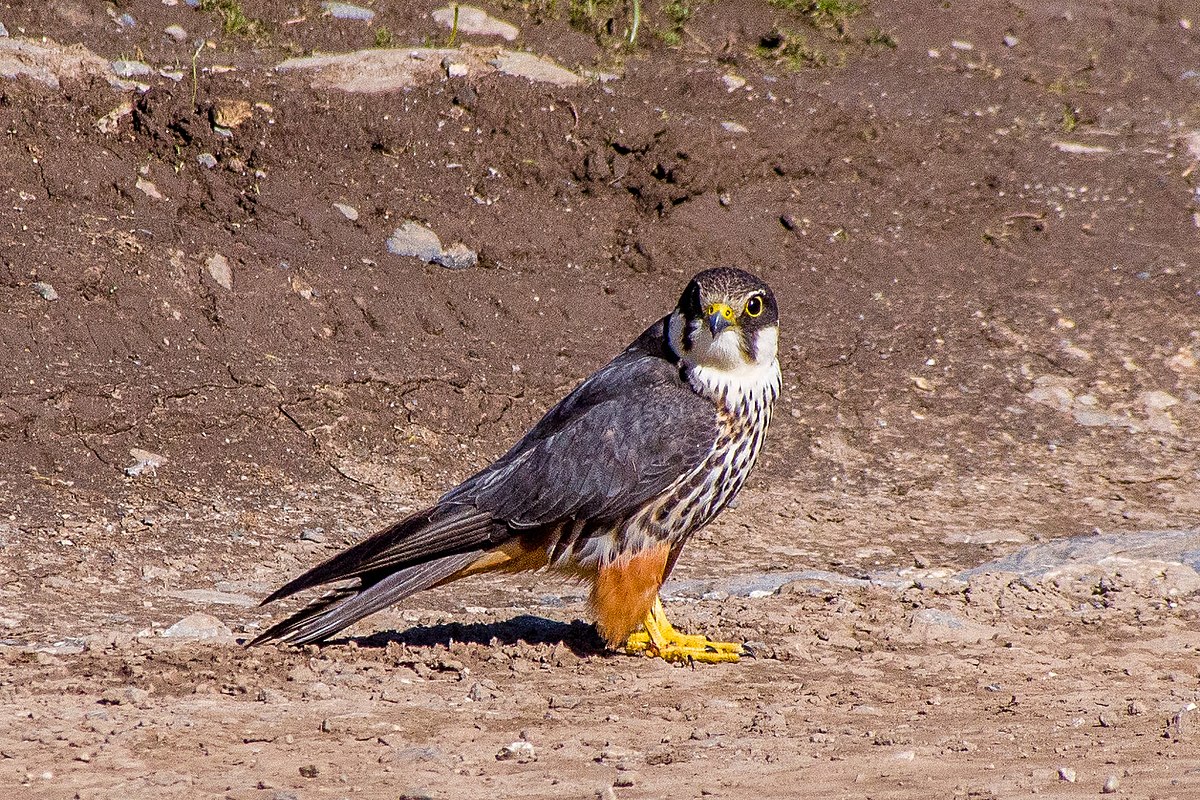
Wikipedia: Eurasian hobby Source: WIKIPEDIA
1200px-Eurasian_Hobby_%2814574008925%29_%28cropped%29.jpg
First observed in 🇨🇭 on 2024-08-14.
Description
General: Deutschland: Brut-, Zugvogel RL 3Etymology: Nabu: 2024 das erste Mal gehört nah beim Rosinli, aus der Ferne gesehen am Klingnauerstausee. [Link]
Vocalization:
Varied, but not very vocal. [Link]
Seasonal behavior
Presence: 04-01 - 10-27 Breeding: 05-01 - 08-29 Migration in: 04-01 - 06-20 Migration out: 08-09 - 10-27More details at Vogelwarte.ch
Other Details
Physical details
Physical details: length=30-36 cm, wingspan=82-92 cm, weight=131-340 gHabitats: Agricultural
Vocalisation
Song: No details but a Xeno-Canto recording. Song attributes: Frequency:♫ 2024-08-14 13:57:00 Greater Fehraltorf (song)
Calls:
Calls when courting and at breeding ground. Most common sound a high-pitched "tew-tew-tew". Similar to Wryneck, but less pleading. Also a sneezing "ktcho". [Link]
General: About 20 single notes.
XC669704 - Eurasian Hobby - Falco subbuteo - call, about twenty peeps.
♫ Source: XENOCANTO XC669704 - Eurasian Hobby - Falco subbuteo - call, about twenty peeps.mp3 (call)

Call attributes: Call melody: non-musical, slow, Frequency: low (1-3 KHz),
Details
Profile Wikipedia Vogelwarte BirdLife ZH ornitho.ch Xeno-Canto BirdID NABU YouTube

Wikipedia: Red-footed falcon Source: WIKIPEDIA
Falco_vespertinus_3_%28Martin_Mecnarowski%29.jpg
🔍
Never observed (yet!)
Description
General: Deutschland: ausnahmsweise Brutvogel, seltener ZugvogelSeasonal behavior
Presence: 04-20 - 10-07 Migration in: 06-09 - 06-17 Migration out: 08-18 - 10-07More details at Vogelwarte.ch
Other Details
Physical details
Physical details: length=29-31 cm, wingspan=66-78 cm, weight=130-197 gHabitats: Agricultural Details

Wikipedia: Peregrine falcon Source: WIKIPEDIA
Falco_peregrinus_good_-_Christopher_Watson.jpg
🔍
Never observed (yet!)
Description
Geography: This bird appears across the great seas in the following continents: Europe, North America, South America, Africa, Asia.General: Deutschland: Brut-, Jahres-, Zugvogel, Wintergast
Vocalization:
A harsh, drawn out "kiaaaa" with emphasised endings repeated in series. Much slower than Merlin, but higher pitched than Gyrfalcon. [Link]
Seasonal behavior
Year-round bird Breeding: 02-20 - 07-10 Migration in: 02-20 - 05-01 Migration out: 08-09 - 11-06More details at Vogelwarte.ch
Other Details
Physical details
Physical details: length=36-48 cm, wingspan=95-110 cm, weight=582-1300 gHabitats: Agricultural
Vocalisation
Song: No details but a Xeno-Canto recording. Song attributes: Frequency:♫ Source: XENOCANTO XC942609 - Peregrine Falcon call - Falco peregrinus.mp3 (call)

Calls:
Also shorter, coarse warning-calls. [Link]
No details but a Xeno-Canto recording.
Call attributes: song Frequency: ,
Details
Profile Wikipedia Vogelwarte BirdLife ZH ornitho.ch Audubon AllAboutBirds Xeno-Canto BirdID NABU YouTube

Wikipedia Datei Falco columbarius Male. Source: WIKIPEDIA
Wikipedia_Datei_Falco_columbarius_Male.jpg
First observed in 🇨🇭 on 2024-05-16.
Description
Geography: This bird appears across the great seas in the following continents: Europe, North America, South America, Africa, Asia.General:
The merlin (Falco columbarius) is a small species of falcon from the Northern Hemisphere,[2] with numerous subspecies throughout North America and Eurasia. A bird of prey, the merlin breeds in the northern Holarctic; some migrate to subtropical and northern tropical regions in winter. Males typically have wingspans of 53–58 centimetres (21–23 in), with females being slightly larger. They are swift fliers and skilled hunters which specialize in preying on small birds in the size range of sparrows to doves and medium-sized shorebirds. In recent decades merlin populations in North America have been significantly increasing, with some merlins becoming so well adapted to city life that they forgo migration; in Europe, populations increased up to about 2000 but have been steady subsequently.[3] The merlin has for centuries been well regarded as a falconry bird.
[more]
Deutschland: Zugvogel, Wintergast
Vocalization:
Series of harsh "kwik-wik wik". Coarseness similar to Peregrine, but pace much quicker. [Link]
Seasonal behavior
Year-round bird Migration in: 02-20 - 03-01 Migration out: 02-22 - 03-01More details at Vogelwarte.ch
Other Details
Physical details
Physical details: length=25-30 cm, wingspan=50-62 cm, weight=125-300 gHabitats: Agricultural Details
Classification not found:
General: 1 species not correctly classifiedBlack kite / Schwarzmilan (Milvus migrans)

Schwarzmilan. 2022-05-22 10:42:20 Leuk
First observed in 🇨🇭 on 2021-04-03.
Description
General: This is on my list of birds to find, as it is supposed to be exist in this area,but I've never identified one. Their call (see Vogelwarte link) is a rapid sequence of whistles, and definitely distinct from that of the red kites. Visually they are harder to tell apart, but if you look closely, it should be clear: the black kite has less of a V in its tail and no big white patch at the wingtips. birdguides.com has a guide to distinguishing black and red kites, and says black are much rarer, but that is not true in Switzerland - Vogelwarte.ch says Switzerland has 2800–3500 red kites and 2000-3000 black kites.General: Tenatively identified one flying high over Lake Lugano at San Salvatore in Ticino.
General: Often near water.
General: Deutschland: Brut-, Zugvogel
Vocalization:
A piercing, first ascending then descending long "piuuu". Starting as a clear tone then gradually taking on a vibrating character that differs from Red Kite. Also a sharp "kieee -ki- ki-ki". More vocal than Red Kite. [Link]
Seasonal behavior
Presence: 02-20 - 10-07 Breeding: 04-01 - 07-20 Migration in: 02-20 - 05-21 Migration out: 07-20 - 10-07More details at Vogelwarte.ch
Other Details
Physical details
Physical details: length=55-60 cm, wingspan=160-180 cm, weight=630-941 gHabitats: Agricultural
Vocalisation
Song: No details but a Xeno-Canto recording. Song attributes: Frequency:♫ 2026-06-18 09:22:00 (song)
Drei fallende Noten
XC884100 - Black Kite - Milvus migrans - flight call.
♫ Source: XENOCANTO XC884100 - Black Kite - Milvus migrans - flight call.mp3 (flight call)

Call attributes: flight call Call melody: simple rhythmic, slow, Frequency: medium (1-5 KHz), Special sounds: swoop.
Details