Bird call combining all the things I should learn better.
Übung| Bird | Description | Audio |
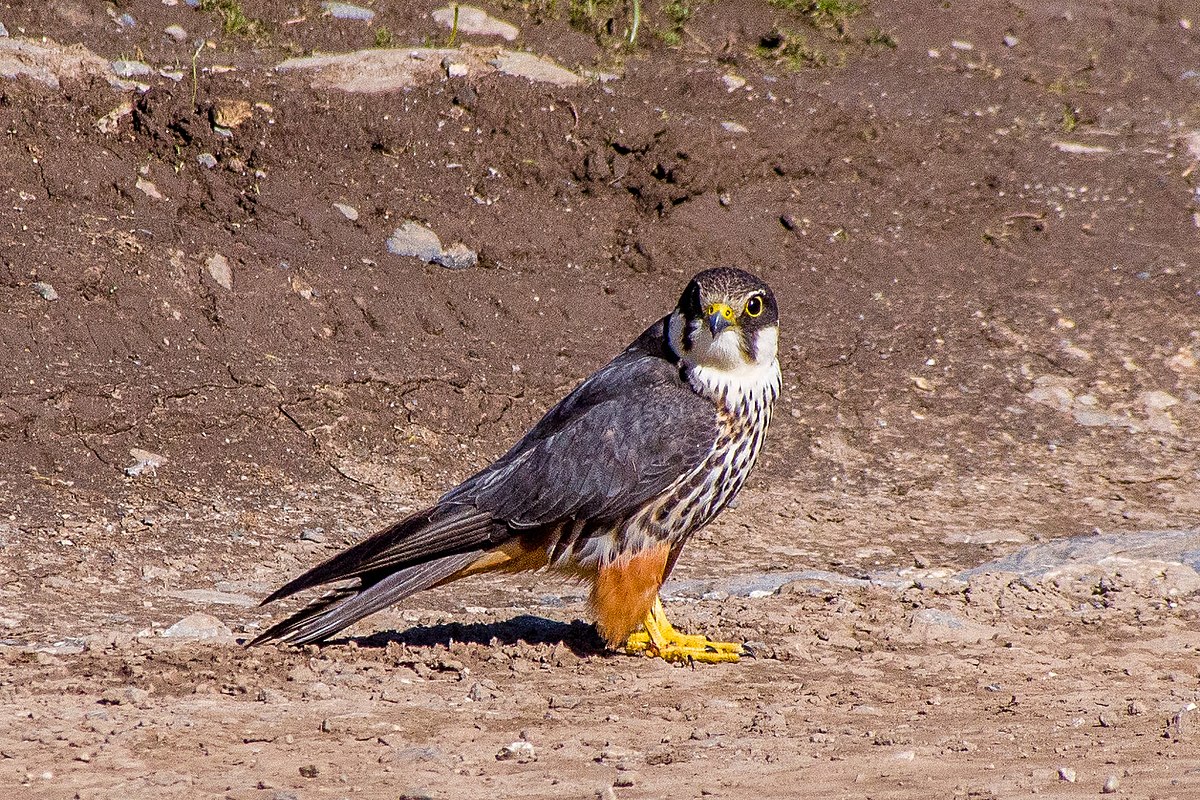 Baumfalke / Eurasian hobby (Falco subbuteo) ■■
 |
No details but a Xeno-Canto recording.
Call:  Calls when courting and at breeding ground. Most common sound a high-pitched "tew-tew-tew". Similar to Wryneck, but less pleading. Also a sneezing "ktcho". [Link] Calls when courting and at breeding ground. Most common sound a high-pitched "tew-tew-tew". Similar to Wryneck, but less pleading. Also a sneezing "ktcho". [Link] | ♫ |
| nicht musikalisch | ||
| trommeln | ||
 Buntspecht / Great spotted woodpecker (Dendrocopos major) ■■
 |
trommeln nicht musikalisch fast low (1-3 KHz) .
Song: Other: ‘Drumming’ is the sound that Great Spotted Woodpeckers make by hammering their bills against dead wood 10-20 times over 2-3 seconds. The sound resonates in the dead wood and can be heard over large distances. This drumming acts as an advert and is used by Great spotted Woodpeckers and other woodpecker species instead of a song. [From the GardenBird web site] Nabu: Manchmal, bei strahlendem Sonnenschein, fangen die Spechte schon im Dezember an zu trommeln. [NABU Vogel des Jahres 1997] Call: Nabu: Das bekannteste Geräusch des schwarz-weißen Spechtes ist aber wohl sein kurzes, aber häufiges Trommeln. [Link]  In a sonogram I can see about 13 taps in just over half a second, but you can never distinguish so many.
It's short but intense, and the second half trails off,
especially contrasted with the constant drumming of the three-toed woodpecker. [[Listen here.]]
Call: Typically it lasts 0.5 seconds, sometimes slightly longer. Contact call frequently hear throughout the year. A short hiccup "kek", sometimes in series. When excited this may escalate into a trill. [Link] In a sonogram I can see about 13 taps in just over half a second, but you can never distinguish so many.
It's short but intense, and the second half trails off,
especially contrasted with the constant drumming of the three-toed woodpecker. [[Listen here.]]
Call: Typically it lasts 0.5 seconds, sometimes slightly longer. Contact call frequently hear throughout the year. A short hiccup "kek", sometimes in series. When excited this may escalate into a trill. [Link] |
♫

|
 Eisvogel / Common kingfisher (Alcedo atthis) ■■
 |
No details but a Xeno-Canto recording.
Call:  Wikipedia says 'The common kingfisher has no song.
The flight call is a short, sharp whistle chee repeated two or three times. Anxious birds emit a harsh, shrit-it-it and nestlings call for food with a churring noise.'
The NABU app only has calls,
which seems to confirm this. Therefore I'm classifying all recordings as calls,
even though some say Song at Xeno-Canto. [Link]Most heard is the thin and penetrating contact call: A short "tzee", or disyllabic "tzee-tzu", with a ringing metallic quality. In excitement it is often alternated with ringing trills "tzeerrrrrrrrrr". [Link] Wikipedia says 'The common kingfisher has no song.
The flight call is a short, sharp whistle chee repeated two or three times. Anxious birds emit a harsh, shrit-it-it and nestlings call for food with a churring noise.'
The NABU app only has calls,
which seems to confirm this. Therefore I'm classifying all recordings as calls,
even though some say Song at Xeno-Canto. [Link]Most heard is the thin and penetrating contact call: A short "tzee", or disyllabic "tzee-tzu", with a ringing metallic quality. In excitement it is often alternated with ringing trills "tzeerrrrrrrrrr". [Link] |
♫

|
| einfach rhythmisch | ||
 Sumpfmeise / Marsh tit (Poecile palustris) 1-Noter, Sumpf laenger als Kohl hhmmlll ■■
 |
einfach rhythmisch fast low-high (2-10 KHz) .
General: Higher-pitched than great tit, sometimes repetitive 1- and 2-note tunes like them, sometimes simple melodies, usually pure, sometimes chirpy or raspy. Song: 'Song: A simple one or two note call repeated in series. Usually rising slightly in pitch, and with a "liquid" quality.'. [Link] At bird-song.ch it's hl-rest-hl, or 7-8 2-noter swoops. bird-song.ch names lh-break-hl as a pistjä call and also has a series of 7 or 8 falling 'swoops'. [Link]
Song: Klapperlied - 6-8 Noten 'angeschlagen' At bird-song.ch it's hl-rest-hl, or 7-8 2-noter swoops. bird-song.ch names lh-break-hl as a pistjä call and also has a series of 7 or 8 falling 'swoops'. [Link]
Song: Klapperlied - 6-8 Noten 'angeschlagen' Klapperlied. Reihe (6-8) weich angeschlagene Töne mittlerer Höhe. Ähnlich der Klappergrasmücke aber weicher. (Sumpf ist weich) Oft auch Rufe wie „psja“ zu hören. Ziemlich scharf u. gepresst. [Link] Klapperlied. Reihe (6-8) weich angeschlagene Töne mittlerer Höhe. Ähnlich der Klappergrasmücke aber weicher. (Sumpf ist weich) Oft auch Rufe wie „psja“ zu hören. Ziemlich scharf u. gepresst. [Link] |
♫

|
| lallen | ||
 Haubenmeise / European crested tit (Lophophanes cristatus) lhlhhh ■■
 |
lallen einfach rhythmisch fast high (3-9 KHz) .
Higher-pitched than great tit - how distinguish from coal tit, etc?
Song: Song: an improvisation over previously described calls. [Link] | ♫ |
 Kohlmeise / Great tit (Parus major) llhllh ■■
 |
einfach rhythmisch slow medium (1-5 KHz) .
Said to have a repertoire as a species of 50 or more different songs, albeit simple ones, up to 10 per individual.
Females prefer a male with a large repertoire. One two-note song sounds like a squeaky bed.
Song: Nabu: Die erste Vogelart, die wir im Jahr hören, ist meistens die Kohlmeise mit ihrem typischen Läuten: "Zip Zäh" oder "Zip zip Zäh". [NABU Experte Lars Lachmann bei Deutschlandfunk Nova]Song highly variable, but usually consisting of two to three notes repeated in a motif. Same birds have many different motifs but generally repeat them many times before switching. Identified by its timbre and often metallic resonant quality, more than by actual phrasing (which is very variable). Often includes buzzing sounds in song. [Link] | ♫ |
| Triller | ||
 Blaumeise / Eurasian blue tit (Cyanistes caeruleus) h ll ■■
 |
Triller einfach rhythmisch slow high (3-9 KHz) .
General: High-pitched, often descending (hhll), occasionally ascending. "Christina compares it to a ping-pong ball dropping. [In Januar singt die Kohlmeise als erster Vogel in Deutschland], dann kommt die Blaumeise dazu. Song: Song: Characteristic, clear, high-pitched, vibrating call. Usually introduced by a couple of accenting syllables, followed by ringing vibrating notes: "ti ti chuhuhuhuhuhuhuhuhuhu". [Link] | ♫ |
| stereotypisch melodisch | ||
| Triller | ||
 Gebirgsstelze / Grey wagtail (Motacilla cinerea) ■■
 |
Triller stereotypisch melodisch fast high (3-9 KHz) .
BirdID says Song simple but variable. I hear trills up to 2 seconds long and chirps. Another description says a series of calls, not very melodic. I noted zwitx3, sometimes hhhhhll. [Link]
Song: Song simple but variable. Sometimes with more elaborate song-flight like White Wagtail. [Link] |
♫

|
 Bartmeise / Bearded reedling (Panurus biarmicus) ■■
 |
No details but a Xeno-Canto recording.
Song: Song a primitive, 3-syllable phrase, consisting of contact call-like sounds. [Link] | ♫ |
| stereotypisch melodisch | ||
 Schwanzmeise / Long-tailed tit (Aegithalos caudatus) Diddly doot-doot-doot-doot hhmll ■■
 |
stereotypisch melodisch slow high (3-9 KHz) .
General: Meistens hört man das Pfief...chk..chk..Pfief von den Rufen, siehe dort. Song: Nabu: Der Gesang ist ein feines Trillern und selten zu hören (someone at XenoCanto compares it to a blue tit trill). [Link] Song: Song: high tsee-tsee; funny downhill trill Song: Rapid, continuous, randomly composed sequence of bubbling,chirping sounds. [Link] |
♫

|
| einfach rhythmisch | ||
 Zilpzalp / Common chiffchaff (Phylloscopus collybita) ■■
 |
einfach rhythmisch slow high (3-9 KHz) .
Seems to consist of 3 notes repeated randomly, occasionally just 2 notes.
Though NABU.de says they stop singing at the end of July, I do hear their 3-note song occasionally in October,
but just one or two repetitions.
Song:  Von Mitte August bis Ende September bringt der Zilpzalp regelmäßig Herbstgesang dar. [Link]Lange Reihen (6-20) von „zilp-zalp“-Rufen, meist abwechselnd in Tonhöhe. (Als bemühe sich der Sänger vergeblich den ersten Ton wieder zu treffen , ohne jedoch weit zu verfehlen.) „Zins zahl, Zins zahl, zahl Zins, Zins Zins zahl“ („Zins“ etwas höher als „zahl“) [Link]Song a very distinct: "chiff-chaff-chiff-chiff-chaff-chiff", in a regular clock-like rhythm. Each syllable at seemingly random pitch, but no large intervals tonally. Sometimes "get stuck" at one note. [Link] Von Mitte August bis Ende September bringt der Zilpzalp regelmäßig Herbstgesang dar. [Link]Lange Reihen (6-20) von „zilp-zalp“-Rufen, meist abwechselnd in Tonhöhe. (Als bemühe sich der Sänger vergeblich den ersten Ton wieder zu treffen , ohne jedoch weit zu verfehlen.) „Zins zahl, Zins zahl, zahl Zins, Zins Zins zahl“ („Zins“ etwas höher als „zahl“) [Link]Song a very distinct: "chiff-chaff-chiff-chiff-chaff-chiff", in a regular clock-like rhythm. Each syllable at seemingly random pitch, but no large intervals tonally. Sometimes "get stuck" at one note. [Link] | ♫ |
| improvisiert melodisch | ||
| Mimikry | ||
 Mönchsgrasmücke / Black cap warbler (Sylvia atricapilla) hml ■■
 |
Mimikry improvisiert melodisch fast medium (2-5 KHz) .
They sometimes sing like a blackbird on speed - also non-stereotypic, seemingly improvised,
in short bursts.
Our local guy ends most of his songs with the same seven notes, which I find a good way to confirm the identification. In Ticino we often heard the 'Leiern' sound - the warblers would sing just the first 3 notes of a longer song, then stop. The order varied; high-medium-low I call 'Figaro' as in the opera, low-high-medium 'whiskey bar', as it sounded to me like the Kurt Weill lyrics, 'O-oh-show me-the-way to-the-next whis-ke-bar' - but the warbler usually stopped after 'way' or 'next' The British authors of The Sound Approach claim to hear 'a warblel and a whistle'.
Song: Mit schwätzendem Vorgesang, (kann auch kurz sein oder ganz fehlen) der dann in klare, kräftige, zum Ende hin in wehmütige Flötentöne übergeht (Überschlag)
[Link]Song pleasing, varied and loud. Sometimes very similar to Garden Warbler. A typical phrase starts with soft, staccato chattering and mimicry, which after a few seconds changes to a much louder, pure and resonant stream of notes for about 3-5 seconds. No fixed motif, but may end phrases with recurring notes. Often deviates from the characteristic type of song, and identification from song alone may be impossible. May sing first part of song for extended periods without ever reaching the characteristic ending. [Link] | ♫ |
| stereotypisch melodisch | ||
| rasseln, flöten | ||
 Stieglitz / European goldfinch (Carduelis carduelis) Llmh ■■
 |
rasseln, flöten stereotypisch melodisch fast low-high (2-7 KHz) .
General: Hektischer Singsang, wirkt recht chaotisch in Futtergruppen. Aber auch als Käfigvogel gehalten, es muss solo schöner klingen. Gesang hat eine Struktur (und ist langsamer als der Girlitz): Zuerst eine kleine Melodie hoch und runter; dann vielleicht ein Grünfink-Triller, dann 4 wiederholte Noten oder ein neues Melodiechen. (Oder kommen diese Elemente eher zufällig?) Song:  Melodie geht meistens 2-3 Sekunden hoch und runter, meistens mit einer wiederholten 1-Noter mit ~6x die gleiche Note. [Link]
Song: My first (multilingual) notes: Stieglitz like Grünfink, fast, high, occasional trills. Occasionally ends a bit with falling note like buchfink Melodie geht meistens 2-3 Sekunden hoch und runter, meistens mit einer wiederholten 1-Noter mit ~6x die gleiche Note. [Link]
Song: My first (multilingual) notes: Stieglitz like Grünfink, fast, high, occasional trills. Occasionally ends a bit with falling note like buchfinkMir wurde erst in St. Moritz in Juli 2021 bewusst wie ähnlich der Stieglitz wie ein Grünfink klingt - beide können lange Gesang mit Trillern und rauhen sinkenden Toenen singen, und ich habe Stieglitz v.a. durch dieses Stöhnen für Grünfink gehalten. Contact-call distinct, and also constitutes a major part of the song. A sharp and explosive "witt", or "tzee-witt". Sometimes given as a single syllable, di- or trisyllabic, or as continuous series. The song is comprised of rapid series of the contact call, interrupted by drawn-out melodic notes and trills. [Link] |
♫

|
| improvisiert melodisch | ||
| flöten | ||
 Rotkehlchen / European robin (Erithacus rubecula) ■■
 |
flöten improvisiert melodisch fast high (3-9 KHz) .
General: Hoch aber auch bis tief, z.B. 2.9-7.7 KHz.
Wikipedia sagt, 'Der Gesang des Rotkehlchens ist mit 275 nachgewiesenen,
sich fortlaufend ändernden Motiven äußerst variabel.
[Ein einzelner Vogel lernt teilweise mehr als 30 verschiedene Strophen, sagteChristina Ebneter in BirdLife Feldornithologie-Kurs.]
Er wird mit vorgestreckter, das Rot betonender Brust, in der Regel von einer hohen Singwarte aus, vorgetragen. Er beginnt etwa eine Stunde vor Sonnenaufgang und ist noch eine gute Zeit nach Sonnenuntergang zu hören, hauptsächlich jedoch während der Dämmerung. Der Revieranzeigegesang wird normalerweise mit perlenden reinen Tönen und Trillern eingeleitet und fällt gegen Ende langsam ab; hohe metallische Töne werden oft dazwischen eingeschoben. Häufig sind in die 2,5 Sekunden langen Strophen auch undeutliche Imitationsphrasen eingelegt. Auf den Menschen wirkt der Reviergesang lieblich und schwermütig melodiös. Ist das Rotkehlchen hochgradig erregt, verdeutlicht es seinen Willen zur Eskalation durch übertönendes oder störendes Singen.' Ich habe in Ticino und Falera festgestellt, dass die Rotkehlchen immer noch singen und habe es nachher auch daheim im Zürcher Oberland gehört; das Ende des Singen Ende Juli ist anscheinend relativ. Seitdem weiss ich dass es eine der wenigen Vogelarten ist, die auch in Winter ein Territorium verteidigt...darum. Song: Only for a short period in late summer while they are moulting and inconspicuous do robins stop singing. Both sexes sing. [RSPB article]
Song: Song medium to very high pitched, with mostly clear tones with a liquid quality. Timbre reminiscent of Wren or Dunnock, but with a much more varied structure and tempo. Pitch ranges from very high to low, almost thrush-like, notes. No recognizable motifs. Often ends on a rising or falling pitch, giving it a "Chinese" accent. [Link] |
♫

|
| stereotypisch melodisch | ||
| churr | ||
 Hausrotschwanz / Black redstart (Phoenicurus ochruros) ■■
 |
churr stereotypisch melodisch slow high (3-9 KHz) .
The song is two parts and unvarying. If it were a pop song, you'd call it ABABAB... The second part starts with a
sputtering trill. The RSPB in the UK says 'warble with crackling trills.' Vogelwarte.ch says
'Der gepresst knirschende Gesang setzt meist lange vor Sonnenaufgang ein und ist der Auftakt für das Vogelkonzert.'
BirdLife-Zuerich.ch says 'Einziger Sänger morgens um drei in den Häuserschluchten'.
Obwohl NABU.de meint, sie singen nicht mehr nach Juli, war ich angenehm überrascht sie in Oktober im Tessin zu hören.
Song: Other: Einige Arten wie der Hausrotschwanz singen zudem im Herbst, bevor sie in ihr Winterquartier ziehen. Die Männchen legen dann ihre Reviere bereits «provisorisch» fest. [Link]Am Morgen der erste Sänger: Kurzes dreiteiliges Liedchen, meist von Warte aus gesungen. Mittelstück aus rauen gequetschten Tönen. (als ob kurz die Stimme verloren)
[Link]Song consists of three parts and is distinct if heard well. It opens with some clear notes that may form a trill, which are then followed by a pause. The "gravel-part" does not carry as far as the rest of the song. [Link] |
♫

|
| improvisiert melodisch | ||
| Schnörkel | ||
 Amsel / Common blackbird (Turdus merula) lmh ■■
 |
Schnörkel improvisiert melodisch slow low-high (1-7 KHz) .
Other: Gut zu erkennen ist die Amsel.
Sie singt melodiös, erklärt Heller, «zuerst flötend und dann gegen Schluss so schnirpslig».
Die Amsel singe gerne dort, wo sie gut gehört werde, etwa vor Hauswänden, die den Schall nicht schlucken.
Ich wollte schauen was schnirpslig heisst, aber diese ist diese einzige Verwendung, die Google kennt!
Der flötende Teil ist relativ tief, 1.5-3 KHz, der schnirpslige aber 2.5-7 KHz.
(Schnirpslig ist ein schones Wort das der Redner erfunden hat - Google findet nur diese eine Webseite mit dem Wort!) [Von der SRF Webseite:]
Song: Melodisch flötend dazwischen auch zerquetschte Töne. Die Elemente werden nicht wiederholt. Singt von Singwarte aus. Ca. 100 verschiedene Strophentypen.
[Link]One of the most appreciated song birds. Very melodious and resonant, with long mellow notes and a large register. Less high pitched sounds than Song Thrush, and seldom repeats a phrase. Timbre fuller than both Song Thrush and Mistle Thrush. Well defined pauses between phrases, giving the song a relaxed pace. [Link] | ♫ |
| stereotypisch melodisch | ||
| Mimikry | ||
 Gartenrotschwanz / Common redstart (Phoenicurus phoenicurus) ■■
 |
Mimikry stereotypisch melodisch slow high (3-9 KHz) .
I though I had these guys figured out after hearing them in Locarno several times, but they're hard to get a handle on! At BirdID they are described the first two parts of a three-part song like this: 'an ascending single note, immediately followed by a trill', whereas in Locarno I heard an initial high-low-high-low, sometimes without the final low, perhaps also a quick middle note, and no trill. Then a relatively short blackbird or warbler-like tune of maybe 5-8 notes. Listening to more recordings at XenoCanto has completely confused me now! BirdID also says the song is similar to the black redstart, which I sometimes hear at XenoCanto, but never did in Locarno! They also note a similarity to the Lesser Whitethroat (Klappergrasmücke), which I hope to hear in Maienfeld.
Song: Fängt immer mit denselben 3 Tönen an, einem „dih dede“, wobei das dih etwa ein bis zwei Töne höher liegt. Dann folgt eine kurze Strophe mehr oder weniger reine Töne. Das Ganze ist ziemlich individuell.
[Link]Song distinct, with three parts: First an ascending single note, immediately followed by a trill, then concluding with a squeaky, rattling improvisation that usually contains some mimicry. [Link] | ♫ |
| singt 20 Sekunden oder länger | ||
| Raspel | ||
 Drosselrohrsänger / Great reed warbler (Acrocephalus arundinaceus) ■■
 |
Raspel singt 20 Sekunden oder länger slow medium (1-5 KHz) .
General: Klingt für mich wie krächz pieps pieps.
Vogelarten der Schweiz sieht das anders:
'Laute und auffällig knarrende, rau tönende Strophe
''karre-kiet karre karre-keit.'' ' Song: In Vergleich zu Teichrohrsänger langsamer und lauter. [Link]
Song: Gesang ähnlich Teichrohrsänger, aber viel lauter, Tonhöhenunterschiede 2-3 Oktaven. Karre-Kit-Sänger.. Sehr taktmässig.
[Link]Song similar to Reed Warbler in timbre, but much deeper and slower. [Link] |
♫

|
| einfach rhythmisch | ||
 Mauersegler / Common swift (Apus apus) ■■
 |
einfach rhythmisch fast high (5-7 KHz) .
Song: Sie singen im Flug (eigentlich LEBEN sie im Flug), und wenn du sie nicht siehst, schau weiter hoch, dann noch einmal - sie können mehrere 100m hoch fliegen oft in Gruppen von 3-10. Kappe abziehen wenn nötig! [Link]A shrilling trill "zreeeee" of about 1 -2 seconds length, gradually rising in pitch with accentuated firs half, then falling from the middle of phrase. Often continued with a dry lower pitched "trrrrrr" before calling again. [Link]
Call: Often continued with a dry lower pitched "trrrrrr" before calling again. Very vocal at breeding area, and often a flock will call together. Despite being quite similar to Pallid Swift, the call is probably the best field character to separate the two. Pallid puts the stress on the ending of the call, followed by a quick fall in pitch (dynamics like moaning with a quick release). Plain Swift calls similar to Common Swift, but differs in slightly fluctuating pitch during the call, and a loss of resonance towards the ending (thinner sounding). [Link] |
♫

|
| stereotypisch melodisch | ||
 Rauchschwalbe / Barn swallow (Hirundo rustica) ■■
 |
stereotypisch melodisch fast medium (2-6 KHz) .
General: Squeaky with occasional buzzes, usually heard in flock. Song: Kann melodisch sein wenn einzeln gehört statt viele zusammen. [Link]
Song: Characteristic calls and song. Song a sparkling, squeaky energetic improvisation with interspersed contact calls, often with diagnostic ending; an electric and drawn-out "su-eerrrrrrrrrrrrrrr". [Link] |
♫

|
 Mehlschwalbe / Common house martin (Delichon urbicum) ■■
 |
stereotypisch melodisch fast low-high (2-7 KHz) .
Song: Mehlschwalbe klingt weniger melodisch als der Rauchschwalbe [Link]Merry improv of chirping, contact call [Link]
Song: Song a merry improvisation of chirping, contact call-like sounds (sometimes recalling a budgerigar). [Link] |
♫

|
 Turmfalke / Common kestrel (Falco tinnunculus) ■■
 |
No details but a Xeno-Canto recording.
Call: Turmfalke kann auch wie einen Specht tönen, scharf und relativ hoch [Link]Most common call a fast series of short, high-pitched "ke-ke-ke". Much less raucous than Merlin or Peregrine. [Link] | ♫ |
 Fahlsegler / Pallid swift (Apus pallidus) ■❑
Infos über Rufe, nicht Gesang!!
Fahlsegler / Pallid swift (Apus pallidus) ■❑
Infos über Rufe, nicht Gesang!!
|
No details but a Xeno-Canto recording.
Call: Common swift has a more even call, with accents on first part, without the sudden pitch-drop. [Link] |
♫

|
Übung
♫ Lösung Amsel / Common blackbird (Turdus merula) Repetitiver, einfallsloser Amsel den ich für einen Misteldrossel gehalten habe, dazu eine Kohlemeise der lmh singt und ich mit einer Tannen-meise gewechselt habe. ♫
Lösung
Drosselrohrsänger / Great reed warbler (Acrocephalus arundinaceus) XC661392 - Great Reed Warbler - Acrocephalus arundinaceus - song.
♫
Lösung
Fahlsegler / Pallid swift (Apus pallidus) XC897963 - Pallid Swift - Apus pallidus - flight call in Portugal.
♫
Lösung
Turmfalke / Common kestrel (Falco tinnunculus) Vogelgesang im Friedhof Sihlfeld, Zürich - MerlinBirdID hat Girlitz, Buchfink, Amsel, Star, Mönchsgrasmücke, Turmfalke und Haussperling gehört.
♫
Lösung
Hausrotschwanz / Black redstart (Phoenicurus ochruros) XC745021 - Black Redstart - Phönicurus ochruros - typical song recorded in Calabria, Italy.
♫
Lösung
Stieglitz / European goldfinch (Carduelis carduelis) XC638230 - European Goldfinch - Cardülis cardülis.
♫
Lösung
Blaumeise / Eurasian blue tit (Cyanistes caeruleus) Blaumeise h-ll, in Zelgli, Fehraltorf.
♫
Lösung
Mauersegler / Common swift (Apus apus) XC813064 - Common Swift song - Apus apus.
♫
Lösung
Buntspecht / Great spotted woodpecker (Dendrocopos major) Great spotted woodpecker drumming
♫
Lösung
Haubenmeise / European crested tit (Lophophanes cristatus) Haubenmeise Ruf lhlhhh bei Hirzli.
♫
Lösung
Rotkehlchen / European robin (Erithacus rubecula) XC782997 - European Robin - Erithacus rubecula - song recorded in Italy.
♫
Lösung
Eisvogel / Common kingfisher (Alcedo atthis) XC839045 - Common Kingfisher - Alcedo atthis - song - Viana do Castelo, Portugal.
♫
Lösung
Rauchschwalbe / Barn swallow (Hirundo rustica) XC768452 - Barn Swallow - Hirundo rustica - song recorded in Denmark, rare recording with just a single bird.
♫
Lösung
Schwanzmeise / Long-tailed tit (Aegithalos caudatus) XC572437 - Long-tailed Tit - Aegithalos caudatus - song.
♫
Lösung
Sumpfmeise / Marsh tit (Poecile palustris) XC727754 - Marsh Tit - Poecile palustris.
♫
Lösung
Mönchsgrasmücke / Black cap warbler (Sylvia atricapilla) Birdnet 1356 - Eurasian Blackcap hml - 2021-03-31 19:12:00 - Eurasian Blackcap - Lugano.
♫
Lösung
Gartenrotschwanz / Common redstart (Phoenicurus phoenicurus) Common redstart an hour before dawn at Casa Egner, Locarno-Muralto.
♫
Lösung
Kohlmeise / Great tit (Parus major) Kohlmeise gesang in Fehraltorf llhllh.
♫
Lösung
Bartmeise / Bearded reedling (Panurus biarmicus) Bartmeise, blaumeise, grünfink calls in Fanel.
♫
Lösung
Zilpzalp / Common chiffchaff (Phylloscopus collybita) Birdnet 968 saw kohlmeise as part of this conversation - Common chiffchaff - Fehraltorf.
♫
Lösung
Gebirgsstelze / Grey wagtail (Motacilla cinerea) XC767550 - Grey Wagtail - Motacilla cinerea - song with trills and a cheek-cheek.
♫
Lösung
Baumfalke / Eurasian hobby (Falco subbuteo) MerlinBirdId meint Baumfalke bei Rosinli, Hittnau.
♫
Lösung
Mehlschwalbe / Common house martin (Delichon urbicum) XC730813 - Common House Martin - Delichon urbicum - song and call according to recordist Fernando Aranguren Jiménez, recorded in Spain.