Bird song classifiers for Jonas Landolt's Waldvoegel online class, including quiz
Decision table for identifying song, including a quiz at the end.
Practice
| Bird | Description | Audio |
| simple rhythmic | ||
 Marsh tit 1-Noter, Sumpf laenger als Kohl hhmmlll ■■
 |
simple rhythmic fast low-high (2-10 KHz) .
General: Higher-pitched than great tit, sometimes repetitive 1- and 2-note tunes like them, sometimes simple melodies, usually pure, sometimes chirpy or raspy. Song:  'Song: A simple one or two note call repeated in series. Usually rising slightly in pitch, and with a "liquid" quality.'. [Link] 'Song: A simple one or two note call repeated in series. Usually rising slightly in pitch, and with a "liquid" quality.'. [Link] At bird-song.ch it's hl-rest-hl, or 7-8 2-noter swoops. bird-song.ch names lh-break-hl as a pistjä call and also has a series of 7 or 8 falling 'swoops'. [Link]
Song: Klapperlied - 6-8 Noten 'angeschlagen' At bird-song.ch it's hl-rest-hl, or 7-8 2-noter swoops. bird-song.ch names lh-break-hl as a pistjä call and also has a series of 7 or 8 falling 'swoops'. [Link]
Song: Klapperlied - 6-8 Noten 'angeschlagen' Klapperlied. Reihe (6-8) weich angeschlagene Töne mittlerer Höhe. Ähnlich der Klappergrasmücke aber weicher. (Sumpf ist weich) Oft auch Rufe wie „psja“ zu hören. Ziemlich scharf u. gepresst. [Link] Klapperlied. Reihe (6-8) weich angeschlagene Töne mittlerer Höhe. Ähnlich der Klappergrasmücke aber weicher. (Sumpf ist weich) Oft auch Rufe wie „psja“ zu hören. Ziemlich scharf u. gepresst. [Link] |
♫

|
| stereotype melodic | ||
 Goldcrest W=Winter=v.a. runter, dann wieder hoch, plus melodischer Schluss ■■
 |
stereotype melodic slow high (6-8 KHz) .
 Vogelwarte.ch says high-pitched song that gently rises and falls. This song starts out with a repeated note. [Link]
Song: Kurze Reihe von sehr hohen, leisen Tönen in auf-absteigender Tonhöhe, an das „W“-im Namen erinnernd. [Link]Song: a very high-pitched, undulating series of arpeggiated notes moving down and up again, repeated 4-5 times ending with a marked "conclusion" (like "trying to start a tiny motor and failing"). Timbre of song similar to contact call. [Link] Vogelwarte.ch says high-pitched song that gently rises and falls. This song starts out with a repeated note. [Link]
Song: Kurze Reihe von sehr hohen, leisen Tönen in auf-absteigender Tonhöhe, an das „W“-im Namen erinnernd. [Link]Song: a very high-pitched, undulating series of arpeggiated notes moving down and up again, repeated 4-5 times ending with a marked "conclusion" (like "trying to start a tiny motor and failing"). Timbre of song similar to contact call. [Link] |
♫

|
| simple rhythmic | ||
 weiblich.jpg) Common firecrest Noten vom 'Sommer' steigen wie die Temperaturen ■■
Common firecrest Noten vom 'Sommer' steigen wie die Temperaturen ■■ |
simple rhythmic fast high (6-8 KHz) .
Very high rhythmic repetition of about 3 seconds
Song: Wie [beim Wintergoldhähnchen] aber auf gleicher Tonhöhe bleibend. [Link]Song: Similar in timbre to Goldcrest, but much more monotonous. [Link] |
♫

|
 Hawfinch ■■
 |
No details but a Xeno-Canto recording.
Call: Most typical call a sharp and explosive "tzek", with abrupt, emphasized, cut-off ending. Quite similar to Robin, but harder, with each syllable marginally longer with a slightly wheezing timbre. Repetitions are slower and more singular than Robin. Diagnostic when interspersed with high frequency notes. [Link] | ♫ |
| one note | ||
 European nuthatch 6x steigt, wie 6-Buchstaben 'Kleber' ll ■■
 |
one note fast medium (1-5 KHz) .
Song: Song a simple series of loud notes [Link]
Song: Other: The song is very variable, with rising and falling notes, sometimes with repetition of excitement calls. [Link] The song is a slow whistled pee-pee-pee with many variants, including a faster version, and may be intermingled with the call. [Link] The song is a slow whistled pee-pee-pee with many variants, including a faster version, and may be intermingled with the call. [Link]Other: Song a simple series of loud notes. [Link] Song a simple series of loud notes. [Link] |
♫

|
| improvised melodic | ||
| trill | ||
 Eurasian wren ■■
 |
trill improvised melodic fast high (3-9 KHz) .
High-pitched, melodic, very variable with many trills and whistles. At least 3 seconds long, switching low to high 6 times or more, always a trill in the mix. Der deutsche Kalendar für 2025 sagt, sie könnten ab Drei-Königs-Tag singen, d.h. ab 6. Januar. nabu.de sagt ab 1. Februar, Drei-Königs-Tag ist eventuell nur wegen dem Namen Zaunkönig? Song: Auffällig laut für den kleinen Vogel. Singt auch im Winter! Schmetternd, mit einem bis zwei Trillern als letztes oder vorletztes Glied.
[Link]Song surprisingly loud. A high-pitched stream of clear notes resembling Robin and Dunnock in timbre. Differs from those in showing frequent shifts in pitch with much larger register than Dunnock, and by the unique, numerous, interspersed long trills. [Link] |
♫

|
| stereotype melodic | ||
 Short-toed treecreeper 'Gar-ten-baum-LÄU-FER' mlLh ■■
 |
stereotype melodic slow high (4-7 KHz) .
It sounds to me like a 5-7 note song like 'five k low high higher', 'short song in the gar-DEN'. The individual notes have the same backward checkmark shape as the call. It's basically the same across Europe.The song of the nominate subspecies is an evenly spaced sequence of notes teet-teet-teet-e-roi-tiit. [Link]Its song is short, loud and rhythmic. [Link] [In comparison with the visually similar Eurasian treecreeper, it] has a clearer, louder more staccato contact call of ‘sreet’ or ‘sree’ and a short ‘wit’ during normal activity [Link]
Song: Kurz u. bündig! (Gartenwege sind kurz.) Tonreihe am Schluss ansteigend. „Hesch du gseh woni bi?
[Link]Song diagnostic, and introductory notes often used singly when interacting. Full song starts with one or two staccato introductory notes, the first higher pitched than the second, followed by a rapid, ascending crescendo ending in a drawn-out, less pure "sree". The tone is loud and much more penetrating and clear than C. familiaris. [Link] [In comparison with the visually similar Eurasian treecreeper, it] has a clearer, louder more staccato contact call of ‘sreet’ or ‘sree’ and a short ‘wit’ during normal activity [Link]
Song: Kurz u. bündig! (Gartenwege sind kurz.) Tonreihe am Schluss ansteigend. „Hesch du gseh woni bi?
[Link]Song diagnostic, and introductory notes often used singly when interacting. Full song starts with one or two staccato introductory notes, the first higher pitched than the second, followed by a rapid, ascending crescendo ending in a drawn-out, less pure "sree". The tone is loud and much more penetrating and clear than C. familiaris. [Link] |
♫

|
 Eurasian treecreeper Waldwege sind lang ■■
 |
stereotype melodic slow medium (1-5 KHz) .
I say: it sounds like a faster higher chaffinch song. Wikipedia says: The male's song begins with srrih, srrih followed in turn by a few twittering notes, a longer descending ripple, and a whistle that falls and then rises.
Song: Lang u. klar! (Waldwege sind lang). Tonreihe im Ganzen absinkend, nur letzter Ton höher. [Link]Song a short, continuous three-part phrase. [Link] |
♫

|
 Dunnock ■■
 |
stereotype melodic fast high (4-8 KHz) .
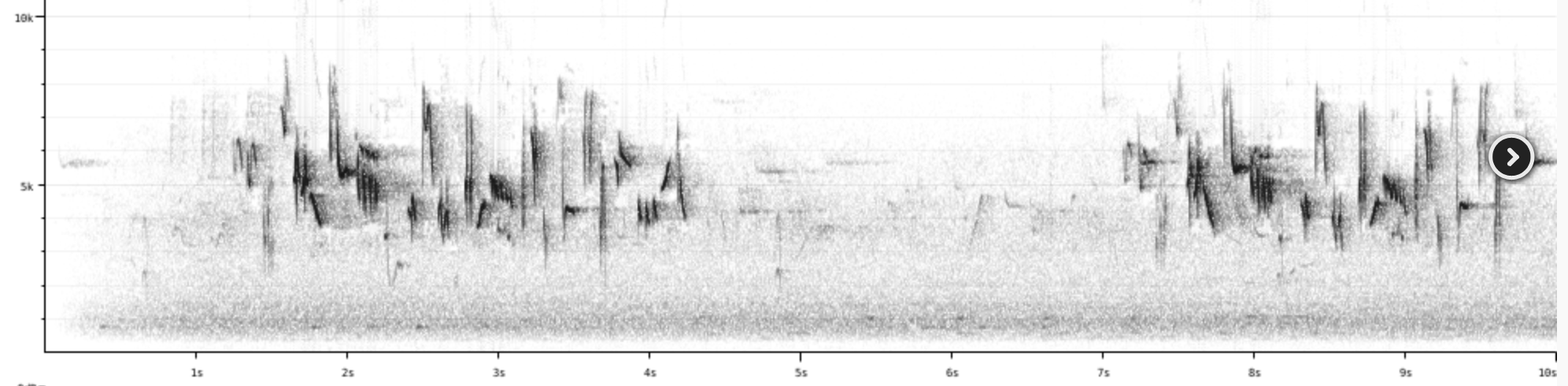
General: High-pitched, repetitive but complex little tune, 3 seconds long with about 15 notes rising and falling, falling at the end, then 3 second pause. Song:  Melodisch, slowly rising, roughly like black-cap warbler, which I guessed in the bird-song.ch quiz. [Link]Schnell wie ein Rotkehlchen aber nicht herunter plätschernd, hoch und runter zwischen 3 und 7 kHz. [Link]
Song: Singt schon im Vorfrühling. Klangfarbe ähnlich Gartenbaumläufer. Aufbau ähnlich Zaunkönig, aber ohne Triller. Viel leiser und dünner.
[Link]Song a fast and evenly paced, high pitched stream of clear notes. No consistent phrasing. Similar in timbre to Robin, but does not vary tempo or pitch nearly as much. Often compared to the sound of a squeaky wheelbarrow. [Link] Melodisch, slowly rising, roughly like black-cap warbler, which I guessed in the bird-song.ch quiz. [Link]Schnell wie ein Rotkehlchen aber nicht herunter plätschernd, hoch und runter zwischen 3 und 7 kHz. [Link]
Song: Singt schon im Vorfrühling. Klangfarbe ähnlich Gartenbaumläufer. Aufbau ähnlich Zaunkönig, aber ohne Triller. Viel leiser und dünner.
[Link]Song a fast and evenly paced, high pitched stream of clear notes. No consistent phrasing. Similar in timbre to Robin, but does not vary tempo or pitch nearly as much. Often compared to the sound of a squeaky wheelbarrow. [Link] |
♫
|
| non-musical | ||
| rattle | ||
 Mistle thrush ■■
 |
rattle non-musical fast low-high (2-9 KHz) .
Song: Die Stimme ist ähnlich wie die vom Pirol. [Link]Gesang ähnlich Amsel, aber eintöniger mit geringerem Tonumfang [auch kürzer, kein schnirpsliges Ende -- Bill] [Link]
Song: Gesang ähnlich dem der Amsel, aber weniger abwechslungsreich und melancholisch, fast weinerlich klingend. Meist von Tannenspitze aus.
[Link]Song loud, far reaching and melodic. Most similar to Blackbird, but pitch is higher, phrases shorter (3-6 notes) and most notably, pauses between phrases are much shorter. All which gives the song a much more hurried feel than that of the Blackbird. Timbre is thinner and slightly shivering, and tonal range more limited. May have recurring favourite motifs, but does not repeat phrases like Song Thrush. Sometimes adds higher pitched parts and imitations. [Link] |
♫

|
Practice
♫
Answer
European nuthatch Is the brevity what makes it a song, whereas calls seem to go on endlessly?
♫
Answer
Dunnock XC778759 - Dunnock - Prunella modularis - song recorded in Spain.
♫
Answer
Short-toed treecreeper XC625133 - Short-toed Treecreeper - Certhia brachydactyla - song.
♫
Answer
Mistle thrush XC800869 - Mistle Thrush - Turdus viscivorus.
♫
Answer
Eurasian treecreeper XC656422 - Eurasian Treecreeper - Certhia familiaris - song, recorded in Sweden.
♫
Answer
Goldcrest Wintergoldhähnchen
♫
Answer
Marsh tit XC727754 - Marsh Tit - Poecile palustris.
♫
Answer
Eurasian wren XC916662 - Eurasian Wren song in China - Troglodytes troglodytes.
♫
Answer
Common firecrest XC769178 - Common Firecrest - Regulus ignicapilla - song recorded in the Netherlands.
♫
Answer
Hawfinch Birdweather-Hawfinch.