Birds of Iceland in taxonomic hierarchy

Spatelenten, Myvatn, Iceland. 2015-06-05 11:20:16
First observed in Iceland on 2015-06-05.
Description
Geography: This bird appears across the great seas in the following continents: Europe, North America.General:
 Barrow's goldeneye (Bucephala islandica) is a medium-sized sea duck of the genus Bucephala, the goldeneyes. This bird was named after Sir John Barrow. The genus name is derived from Ancient Greek boukephalos, "bullheaded", from bous, "bull " and kephale, "head", a reference to the bulbous head shape of the bufflehead. The species name islandica means Iceland.[2]
[more]
Barrow's goldeneye (Bucephala islandica) is a medium-sized sea duck of the genus Bucephala, the goldeneyes. This bird was named after Sir John Barrow. The genus name is derived from Ancient Greek boukephalos, "bullheaded", from bous, "bull " and kephale, "head", a reference to the bulbous head shape of the bufflehead. The species name islandica means Iceland.[2]
[more]
Details
Profile Wikipedia Vogelwarte BirdLife ZH ornitho.ch Audubon AllAboutBirds Xeno-Canto BirdID NABU YouTube

Mittelsäger-Paar im Luppmen in Fehraltorf. 2025-02-03 16:58:13 Luppmen
First observed in 🇨🇭 on 2021-04-06.
Description
Geography: This bird appears across the great seas in the following continents: Europe, North America, South America, Asia.General: Deutschland: Brut-, Zugvogel, Wintergast RL R
Personal notes:
 Zuerst gesehen in Lago Maggiore in Locarno. Jan 2022 auch als Wintergast am Pfäffikersee. [Link]
Appearance and identification:
 In winter you can admire a few of these birds with the straggly tuft. [Link]
Seasonal behavior
Year-round bird Breeding: 05-01 - 07-29 Migration in: 10-18 - 12-31 Migration out: 02-20 - 05-21More details at Vogelwarte.ch
Other Details
Physical details
Physical details: length=52-58 cm, wingspan=70-86 cm, weight=900-1350 gHabitats: River and lake
Similar species
Looks similar to: Greater scaup. Details

Gänsesäger Weibchen mit dem Punk-Look, Locarno. 2024-09-02 15:51:02 Locarno
First observed in 🇨🇭 on 2021-01-26.
Description
Geography: This bird appears across the great seas in the following continents: Europe, North America.General: Zuerst gesehen am Pfäffikersee.
General: Deutschland: Brut-, Zugvogel, Wintergast RL 2
Vocalization:
 Male: Mostly heard when courting. A twanging, disyllabic "whip-ooooo", first syllable ascending and second whistle-like and rapidly falling. Female: A coarse "ahrrr ahrrrr", or a raspy drawn "ah-ahrrrrrr ah-ahrrrrr", slightly rising, then falling in pitch. Also various cackling sounds. [Link]
Seasonal behavior
Year-round bird Breeding: 03-23 - 07-20 Migration in: 01-01 - 04-11 Migration out: 10-27 - 12-31More details at Vogelwarte.ch
Other Details
Physical details
Physical details: length=58-66 cm, wingspan=82-97 cm, weight=900-2100 gHabitats: River and lake
Vocalisation
Song: No details but a Xeno-Canto recording. Song attributes: Frequency:♫ 2021-05-10 09:09:39 Source: BirdNet 20210510_090939 birdnet 1539 - Common Merganser plus Golden Oriole - = - Common Merganser - Locarno.mp3 Locarno (song)
Details

Eiderente Männchen am Zürichsee bei Rapperswil. 2022-11-06 14:14:32 Rapperswil
First observed in Iceland on 2015-06-09.
Description
Geography: This bird appears across the great seas in the following continents: Europe, North America.General: Deutschland: Brut-, Jahres-, Zugvogel, Wintergast
Etymology: Nabu: Auch heute noch erinnert ihr wissenschaftlicher Name an die Bedeutung ihrer isolierenden Daunen für die Menschen. Übersetzt bedeutet ihr Name nämlich „die Allerweichste mit dem schwarzen Körper“. [Link]
Ihr Ruf klingt heiserer und ist lautmalerisch mit gro-gro-ó umschrieben. [Link]
Geography:
Die im Norden Europas häufige und wegen ihren Daunenfedern bekannte Eiderente war in der Schweiz früher ein seltener Gast. Doch in der zweiten Hälfte des 20. Jahrhunderts erfolgten mehrere grosse Einflüge. Dank der Wandermuschelvermehrung war das Nahrungsangebot ausreichend und die Vögel verbrachten zunehmend den Sommer bei uns. Mittlerweile gehört die Eiderente sogar zu den Brutvögeln, was für einen ans Meer angepassten Vogel bemerkenswert ist. [Link]
Other Details
Physical details
Physical details: length=50-71 cm, wingspan=80-108 cm, weight=1500-2800 gHabitats: River and lake Details

Stockente Weibchen. 2024-08-02 15:56:02 Greifensee
First observed in 🇨🇭 on 2020-05-20.
Description
This bird appears across the great seas in the following continents: Europe, North America, South America, Africa, Asia.General: Common waterbird at Pfäffikersee
General: Deutschland: Brut-, Jahres-, Zugvogel, Wintergast
Etymology:
Der heutige Name kann als Hinweis auf ihre Brutplätze verstanden werden, zu denen auf Stock gesetzte Weiden, Weidengebüsch oder auch Reisighaufen gehören.
['Stock' wird weiter erklärt: Als Stockausschlag bezeichnet man bei Bäumen und Sträuchern Triebe, die nach dem Verlust der primären Sprossachse
neu aus dem Stumpf oder Stubben (der dann „Stock“ genannt wird) austreiben.] [Link]
The name 'was derived from the Old French malart or mallart for "wild drake"' [Link]
Dazu zählt der charakteristische Grunzpfiff der Männchen, der lautmalerisch mit „gerijib“ oder „fihb“ umschrieben wird. [Link]
Vocalization:
Female: A distinct coarse, laughing quacking; "haaa ha ha ha ha ha", with first note accented and then descending in pitch. Male: a more silent, very nasal "rriib". [Link]
Seasonal behavior
Year-round bird Breeding: 03-12 - 07-29 Migration in: 02-01 - 05-01 Migration out: 07-29 - 12-31More details at Vogelwarte.ch
Other Details
Physical details
Physical details: length=50-65 cm, wingspan=81-98 cm, weight=750-1450 gHabitats: River and lake Details

Krickente Männchen, Klingnauerstausee. 2022-02-05 12:51:34 Klingnauer Stausee (man-made lake)
First observed in 🇨🇭 on 2021-01-26.
Description
Geography: This bird appears across the great seas in the following continents: Europe, North America, South America, Africa, Asia.General: Wintergast am Teich am Aa-Bach beim Südende des Pfäffikersee
General: Deutschland: Brut-, Jahres-, Zugvogel, Wintergast RL 3
Etymology:
Die hellen «krrik»-Rufe der stimmfreudigen Erpel verhalfen dieser Art zu ihrem deutschen Namen. [Link]
Vocalization:
Male: characteristic, short, highly resonant and metallic "plytt". A bit similar to Pintail, but higher pitched and lacking accompanying whistling sound. Female: various quacking sounds generally quicker paced, more nasal and noticeably higher pitched than Mallard. [Link]
Other Details
Physical details
Physical details: length=34-38 cm, wingspan=58-64 cm, weight=200-450 gHabitats: River and lake
Vocalisation
Song: No details but a Xeno-Canto recording. Song attributes: Frequency:♫ Source: XENOCANTO XC619133-Krickente von Peter Bosman, Belgium.mp3 (song)

Blup blup, fast wie vom Computer generiert, fur mich nohe Noten (obwohl Sonogram nur 2.5 KHz zeigt)
Call attributes: Call melody: simple rhythmic, slow, Frequency: low (1-3 KHz),
Details
Profile Wikipedia Vogelwarte BirdLife ZH ornitho.ch Audubon AllAboutBirds Xeno-Canto NABU YouTube

Spiessente plus 2 Hockerschwäne. 2024-12-07 12:01:46
First observed in 🇨🇭 on 2022-01-27.
Description
Geography: This bird appears across the great seas in the following continents: Europe, North America, South America, Africa, Asia.General: Long tailfeathers make the name obvious, also a thin white stripe from the white neck up the back of the head.
General: Deutschland: Brut-, Jahres-, Zugvogel, Wintergast RL 3
Vocalization:
Female: similar to Mallards coarse laughing sound, but with a more emphasized first "haaa", and a more silent accelerating subsequent "laugh". Male: Pleasant, resonant "plop" similar to Teal, but lower pitched, richer, mellower and not so metallic. Accompanied by a higher pitched, slightly raspy whistling "aiiooo" rising and falling in pitch. [Link]
Seasonal behavior
Year-round bird Migration in: 02-01 - 05-10 Migration out: 08-18 - 12-07More details at Vogelwarte.ch
Other Details
Physical details
Physical details: length=51-66 cm, wingspan=51-66 cm, weight=500-1100 gHabitats: River and lake Details

The big gull is a Mittelmeermoewe then there's a Lachmoewe and two Pfeifenten. 2025-09-13 14:11:02 Klingnauer Stausee (man-made lake)
First observed in 🇨🇭 on 2021-02-24.
Description
Geography: This bird appears across the great seas in the following continents: Europe, North America, Africa, Asia.General: Deutschland: Zugvogel, Wintergast
Etymology:
Es ist der Ruf des Männchens, der zu dem deutschen Namen der Art geführt hat. Das Männchen leitet seine kurzen, scharfen, zwei- bis dreisilbigen pfeifenden wiu-Rufe häufig mit einem krr krkrkrr ein. [Link]
Appearance and identification: Funny red head (made me confused it with the Kolbente) that's brown with a golden forehead (Kolbente is brown, a bit lighter at the back of the head) is the obvious characteristic. Also has a nice black and white pattern on its back and wings with white-rimmed black feathers at the end of the wing, a bit of white before a black butt.
Vocalization:
Male: a pleasant high pitched whistle "piiiiuuu", rapidly rising in pitch and then falling. Quite vocal. Female: a harsh "kraaa kraaa kraa" more like female diving-ducks than other dabbling-ducks. [Link]
Seasonal behavior
Year-round bird Migration in: 02-20 - 05-10 Migration out: 09-07 - 12-31More details at Vogelwarte.ch
Other Details
Physical details
Physical details: length=45-51 cm, wingspan=75-86 cm, weight=500-1000 gHabitats: River and lake
Vocalisation
Song: No details but a Xeno-Canto recording. Song attributes: Frequency:♫ Source: XENOCANTO XC613742-Pfeifente von Adrien Mauss.mp3 (song)

Pfeifen, fast wie ein Rotmilan oder Mäusebussard. Ton steigt und fällt!
Call attributes: Call melody: simple rhythmic, slow, Frequency: low (1-3 KHz),
Details

MerlinBirdID meint Schnatterente - ich habe gehofft herauszufinden welche Ente das typische Gelbe da hinten hat. 2022-02-05 14:34:58 Klingnauer Stausee (man-made lake)
First observed in 🇨🇭 on 2021-02-08.
Description
Geography: This bird appears across the great seas in the following continents: Europe, North America, South America, Africa, Asia.General: In my mind this is the chocolate duck.
General: Deutschland: Brutvogel im 19. Jahrhundert aus Osteuropa und Asien zugewandert
Etymology:
The etymology of the word gadwall is not known, but the name has been in use since 1666.[9] [Link]
Nabu: Die Schnatterente fällt aber – wie ihr Name schon vermuten lässt – durch ihre Art der Nahrungssuche auf. Sie durchschnattert das Wasser mit ihrem Schnabel. [Link]
Appearance and identification: Chocolate bill, black-and-white pattern on head, shoulders, belly, sides of wings, chocolate patterned wings, black butt, a bit of white before the butt.
Appearance and identification: Nabu: Die Schnatterente ähnelt auf den ersten Blick so sehr der weiblichen Stockente, dass man diese schnell verwechseln kann. [Link]
Seasonal Behavior: Wintergast am Greifensee.
Seasonal behavior
Year-round bird Breeding: 04-20 - 07-20 Migration in: 02-20 - 05-21 Migration out: 07-20 - 12-31More details at Vogelwarte.ch
Other Details
Physical details
Physical details: length=46-56 cm, wingspan=84-95 cm, weight=550-1000 gHabitats: River and lake
Vocalisation
Song: No details but a Xeno-Canto recording. Song attributes: Frequency:♫ 2021-10-24 13:12:46
 Source: Zoom H6/H2n Neeracherried (song)
Details

Reiherenten am Klingnauerstausee, zwei Weibchen, zwei Männchen. 2022-02-05 14:39:46 Klingnauer Stausee (man-made lake)
First observed in Iceland on 2015-06-05.
Description
General: Schwarz-weiss mit Muster auf Rücken/Flügel, gelbe Augen, blau-grauer Schnabel mit schwarzer SpitzeGeneral: On a lake in wintertime.
General: Deutschland: Brut-, Jahres-, Zugvogel, Wintergast um 1900 in Deutschland eingewandert, seit 1930 offiziell Brutvogel
Geography:
'Die Reiherente ... zählt zu den so genannten Tauchenten und gilt als die häufigste Süßwassertauchente. Es handelt sich um eine verhältnismäßig kleine, kompakt gebaute Ente. Auffällig sind der verhältnismäßig kurze Schnabel und der auffällig runde Kopf. Die Männchen haben am Hinterkopf einen langen, herabhängenden Schopf. Das Weibchen weist eine kurze Holle auf.
Die Reiherente ist in Mitteleuropa ein verbreiteter Brut- und Jahresvogel',
und in der Schweiz ein Wintergast. [Link]
Vocalization:
Male display sound: High pitched short whistling-like noises, "pjuu-uu", not very audible. [Link]
Seasonal behavior
Year-round bird Breeding: 05-10 - 08-09 Migration in: 01-01 - 05-10 Migration out: 07-10 - 12-31More details at Vogelwarte.ch
Other Details
Physical details
Physical details: length=40-47 cm, wingspan=67-73 cm, weight=500-1000 gHabitats: River and lake Details

Wikipedia: Greater scaup Source: WIKIPEDIA
1200px-Greater-scaup-male2.jpg
🔍
Never observed (yet!)
Description
Geography: This bird appears across the great seas in the following continents: Europe, North America, Asia.General: Deutschland: Zugvogel, Wintergast RL R
Seasonal behavior
Year-round bird Migration in: 01-21 - 01-29 Migration out: 01-21 - 02-20More details at Vogelwarte.ch
Other Details
Physical details
Physical details: length=42-51 cm, wingspan=72-84 cm, weight=700-1300 gHabitats: River and lake
Similar species
Looks similar to: Red-breasted merganser. DetailsProfile Wikipedia Audubon AllAboutBirds Xeno-Canto BirdID NABU YouTube

Wikipedia: Harlequin duck Source: WIKIPEDIA
1200px-Histrionicus_histrionicus_drake_Barnegat.jpg
🔍
Never observed (yet!)
Description
Geography: This bird appears across the great seas in the following continents: Europe, North America.General:
The harlequin duck (Histrionicus histrionicus) is a small sea duck. It takes its name from Harlequin (French Arlequin, Italian Arlecchino), a colourfully dressed character in Commedia dell'arte. The species name comes from the Latin word "histrio", meaning "actor".[2] In North America it is also known as lords and ladies. Other names include painted duck, totem pole duck, rock duck, glacier duck, mountain duck, white-eyed diver, squeaker and blue streak.
[more]
Details
Profile Wikipedia Vogelwarte BirdLife ZH ornitho.ch Audubon AllAboutBirds Xeno-Canto BirdID NABU YouTube

Wikipedia: Long-tailed duck Source: WIKIPEDIA
Long-tailed-duck.jpg
🔍
Never observed (yet!)
Description
Geography: This bird appears across the great seas in the following continents: Europe, North America, Asia.General: Deutschland: Zugvogel, Wintergast
Vocalization:
Very vocal and distinct. Male: a pleasant resonant melodic "ahh-aaooee" in a yodeling, breaking triad. Starting with an accented first note (ahh), then gliding from first through second and third note (-aaoooeee). Far carrying. [Link]
Seasonal behavior
Year-round bird Migration in: 03-15 - 03-23 Migration out: 03-01 - 03-23More details at Vogelwarte.ch
Other Details
Physical details
Physical details: length=40-47 cm, wingspan=40-47 cm, weight=550-900 gHabitats: River and lake Details

Wikipedia: Common scoter Source: WIKIPEDIA
1200px-Eurasian_common_scoter.jpg
🔍
Never observed (yet!)
Description
Geography: This bird appears across the great seas in the following continents: Europe, North America, Africa.General:
Anas nigra Linnaeus, 1758
[more]
Vocalization:
More vocal than other Scoters. Short, whistling sounds, sometimes reminiscent of a male teal, but a little bit deeper in pitch. [Link]
Seasonal behavior
Year-round bird Migration in: 03-15 - 03-23 Migration out: 03-01 - 03-23More details at Vogelwarte.ch
Other Details
Physical details
Physical details: length=44-54 cm, wingspan=79-90 cm, weight=650-1300 gHabitats: River and lake Details

Rote Fuesse und Schnabel koennten auch eine andere Gansart sein, aber die Streifen sind die vom Graugans. 2022-06-04 11:21:54 Kaltbrunner-Riet
First observed in 🇨🇭 on 2021-02-26.
Description
General: Found on practically all Swiss lakes, especially north of the alps.General: Deutschland: Brut-, Jahres-, Zugvogel, Wintergast
Appearance and identification:
Grösste europäische Wildgans. [Link]
Vocalization:
Various cackling and honking sounds "gaiiiaia-ga-ga". [Link]
Other Details
Physical details
Physical details: length=75-90 cm, wingspan=147-180 cm, weight=2100-4300 gHabitats: River and lake Details
Profile Wikipedia Xeno-Canto NABU YouTube
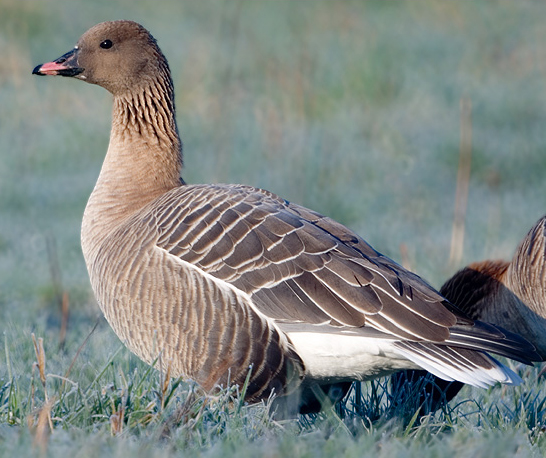
Wikipedia: Pink-footed goose Source: WIKIPEDIA
KurzschnabelgansRL.jpg
🔍
Never observed (yet!)
Description
General: Deutschland: Zugvogel, Wintergast Bruten gehen auf entflogene Tiere zurückVocalization:
Similar to Bean Goose and White-fronted Goose, but more nasal and a little higher pitched than the first, and less musical and laughing than the second. Easily told from Greylag Goose by frequent nasal, high pitched "wink-wink". [Link]
Other Details
Physical details
Physical details: length=60-75 cm, wingspan=135-170 cm, weight=1800-3300 gDetails

Wikipedia: Taiga bean goose Source: WIKIPEDIA
Bean.goose.600pix.jpg
🔍
Never observed (yet!)
Description
Geography: This bird appears across the great seas in the following continents: Europe, North America, Africa.General: Deutschland: Zugvogel, Wintergast Bruten gehen auf entflogene Tiere zurück
Other Details
Physical details
Physical details: length=66-84 cm, wingspan=142-175 cm, weight=2220-4060 gHabitats: River and lake Details

White-fronted goose closeup, on the way home from Laphroiag? 2023-08-11 13:38:38 Scotland
First observed in Scotland on 2023-08-11.
Description
Geography: This bird appears across the great seas in the following continents: Europe, North America, Africa, Asia.General: Deutschland: Zugvogel, Wintergast Bruten gehen auf entflogene Tiere zurück
Vocalization:
Similar to Bean- and Greylag Goose, but higher pitched, more musical, often disyllabic and with a laughing quality. Far from as high pitched as Lesser White-fronted Goose. [Link]
Other Details
Physical details
Physical details: length=65-78 cm, wingspan=130-165 cm, weight=1800-3100 gHabitats: River and lake Details

Whooper swan, Iceland. 2015-06-03 16:01:16
First observed in Iceland on 2015-06-03.
Description
Geography: This bird appears across the great seas in the following continents: Europe, North America.General: Deutschland: Zugvogel, Wintergast RL R
Vocalization:
Quite vocal. Trumpet-like clear honks of half a second length most frequent in flight and take-off/landing. Often voiced with a register break. [Link]
Seasonal behavior
Year-round bird Migration in: 03-12 - 03-19 Migration out: 02-20 - 03-12More details at Vogelwarte.ch
Other Details
Physical details
Physical details: length=145-160 cm, wingspan=218-243 cm, weight=8500-10000 gHabitats: River and lake
Vocalisation
Song: No details but a Xeno-Canto recording. Song attributes: Frequency:♫ 2024-12-07 10:28:00 (song)
Details

Weisswangengans am Pfäffikersee. 2021-04-22 11:35:12 Pfäffikersee
First observed in 🇨🇭 on 2021-04-22.
Description
General: Deutschland: Brut-, Jahresvogel, Wintergast nach 1975 in Deutschland brütendVocalization:
Voice: Quite vocal. Also other lower, grunting sounds when grazing. [Link]
Other Details
Physical details
Physical details: length=58-70 cm, wingspan=132-145 cm, weight=1300-2200 gDetails

Wikipedia: Brant Source: WIKIPEDIA
Brent-Goose.jpg
🔍
Never observed (yet!)
Description
Geography: This bird appears across the great seas in the following continents: Europe, North America.General: Deutschland: Zugvogel, Wintergast
Vocalization:
A bubbling, trembling, ascending, three syllable "ahrahrrhit", quite different from other geese. [Link]
Seasonal behavior
Year-round bird Migration in: 11-26 - 12-31 Migration out: 03-12 - 04-20More details at Vogelwarte.ch
Other Details
Physical details
Physical details: length=56-61 cm, wingspan=110-120 cm, weight=1300-1600 gDetails
Great cormorant / Kormoran (Phalacrocorax carbo)
Profile Wikipedia Vogelwarte BirdLife ZH ornitho.ch Audubon AllAboutBirds Xeno-Canto NABU YouTube

Kormoran im Profil. 2024-05-22 17:14:35 Fanel/Chablais de Cudrefin und La Sauge
First observed in 🇨🇭 on 2021-01-26.
Description
Geography: This bird appears across the great seas in the following continents: Europe, North America, Africa, Asia.General: Deutschland: Brut-, Jahres-, Zugvogel, Wintergast
Seasonal Behavior:
Lokaler Brutvogel, regelmässiger, häufiger Durchzügler und Wintergast.[Brutpaare am Zürichsee und Greifensee bei Mönchaltorf] [Link]
Vocalization:
Mostly heard at breeding ground. Also deep, rattling and creaking sounds. [Link]
Seasonal behavior
Year-round birdOther Details
Physical details
Physical details: length=80-100 cm, wingspan=130-160 cm, weight=1700-3000 gHabitats: River and lake
Vocalisation
Song: No details but a Xeno-Canto recording. Song attributes: Frequency:♫ 2021-05-19 07:39:23 Source: BirdNet 20210519_073923 birdnet 1559 - Great Cormorant - 2021-05-19 07:39:23 - Great Cormorant - Cudrefin.mp3 Fanel/Chablais de Cudrefin und La Sauge (song)
Calls:
Coarse, vibrating calls "hahahahaharo". [Link]
No details but a Xeno-Canto recording.
XC770245 - Great Cormorant call - Phalacrocorax carbo.
♫ Source: XENOCANTO XC770245 - Great Cormorant call - Phalacrocorax carbo.mp3 (call)

Call attributes: song Frequency: ,
Details
European shag / Krähenscharbe (Gulosus aristotelis)

Krähenscharbe pasr oder European shag on boat tour at Chioggia. 2025-09-26 11:30:23 Chioggia
First observed in Chioggia on 2025-09-26.
Description
Appearance and identification: Der Bewohner von Meeresküsten ist eine zierliche Ausgabe des grossen Verwandten [der Kormoran]. Sein schnabel ist dünner und die Stirn steiler ansteigend. Der Kopf trägt einenn kleinen Schopf. [Link]
Details
Northern gannet / Basstölpel (Morus bassanus)

Wikipedia: Northern gannet Source: WIKIPEDIA
1200px-Morus_bassanus_adu.jpg
🔍
Never observed (yet!)
Description
Geography: This bird appears across the great seas in the following continents: Europe, North America, Africa.General: Deutschland: Brut-, Jahres-, Zugvogel, Wintergast RL R
Vocalization:
Heard mostly at breeding ground. Even, rhythmical series of harsh "harrr, harrr, harrr,". [Link]
Other Details
Physical details
Physical details: length=87-100 cm, wingspan=165-180 cm, weight=2400-3600 gDetails

Eine Seltenheit - ein Birkenzeisig im Baum bei Binario 3 in Fehraltorf. 2025-12-04 12:09:03 Ich habe den Vogel weit weg im Baum bei Binario 3 gesehen, und war neugierig (wie immer) und habe mein 200-800mm Telefoto geschnappt. Ohne das hätte ich es nicht identifizieren können. Beim ersten Blick auf die Fotos habe ich gedacht, es könnte ein Sperling sein, aber sie sind meistens sehr sozial, und hier war nur ein Vogel hoch in dem Baum. Und vor allen die kleinen Streifen auf dem Bauch haben nicht gepasst. Das wäre eher ein Drossel. "Die Vogel App!" hat 18 Möglichkeit gefunden, aber ich bin nicht schlauer geworden. Dann habe ich MerlinBirdID gefragt, was im besten Foto erscheint, und es hat gesagt Birkenzeisig. Das war (weil es alphabetisch geordnet ist) die erste Art in der Vogel App Liste. Und bisher hatte ich einen nur einmal einen Birkenzeisig gesehen in Andermatt auf einem FOK3 Ausflug. Übrigens, bei ornitho.ch wird es Alpenbirkenzeisig genannt. Ich habe dort geschaut, ob andere in Kanton Zürich einen Birkenzeisig gesehen haben, und in den letzen Tagen ja in Winterthur, Chatzenseen und Wädenswil. Fehraltorf
First observed in 🇨🇭 on 2025-06-14.
Description
Geography: This bird appears across the great seas in the following continents: Europe, North America, Australia.General: Es gibt Streit um den Namen, vor allem ob der Alpenbirkenzeisig eine Underart oder eingene Art ist. Wikipedia sagt das erste, ornitho das zweite, usw. Ich habe das Problem für mich gelöst, indem ich die Mehrheit respektiere; wenn Alpenbirkenzeisig erwähnt wird, wird es hier as Birkenzeisig gezeigt.
General: Deutschland: Zugvogel, Wintergast
Etymology: Nachdem ich bei uns in 2025 einen Birkenzeisig gesehen, wurde ich neugierig wegen dem Namen. Der deutsche Name kommt von westschlavischen Sprachen. Google AI fasst so zusammen: Der Name "Zeisig" stammt aus dem Westslawischen abäleitet von Wörtern wie tschechisch "čížek" oder polnisch "czyżyk" (kleiner Zeisig) und wurde im 13./14. Jahrhundert ins Deutsche entlehnt, ursprünglich als "zīse" im Mittelhochdeutschen. ... Die ursprüngliche slawische Form "čižb" (Zeisig) und die Diminutivform "čižbkb" (kleiner Zeisig) sind lautmalerischen Ursprungs und spiegeln möglicherweise den Ruf des Vogels wider ähnlich dem ukrainischen "unù Bu?" (wer seid ihr?).
Etymology: The ‘poll’ part of the English name ‘Redpoll’ refers to a old word for ‘head’. [Link]
Appearance and identification: roter Punkt auf Kopf, sonst weiss+braun, teilweise hell-rot auf brust.
Behavior:
Trotz Ihrer roten Abzeichen sind die bräunlich-weiss gestreiften Vögel wenig auffällig, und wenn sie nicht gerade rufen, bleiben sie meist unentdeckt. Oft fliegen sie unvermittelt auf, drehen im Schwarm eine Runde und fallen wieder ein. [Link]
Seasonal behavior
Seldom seen here Year-round bird Breeding: 05-21 - 08-18 Migration in: 03-01 - 05-01 Migration out: 08-29 - 10-27More details at Vogelwarte.ch
Other Details
Physical details
Physical details: length=11-14 cm, wingspan=20-25 cm, weight=9-16 gHabitats: Mountain
Vocalisation
Song: A few chirps and a trill, then repeat. Song:Song an improvised chattering on various contact calls with no apparent phrasing. [Link]
Song attributes:
Melody: simple rhythmic, fast, Frequency: 2-6 KHz Special sounds: trill
Details
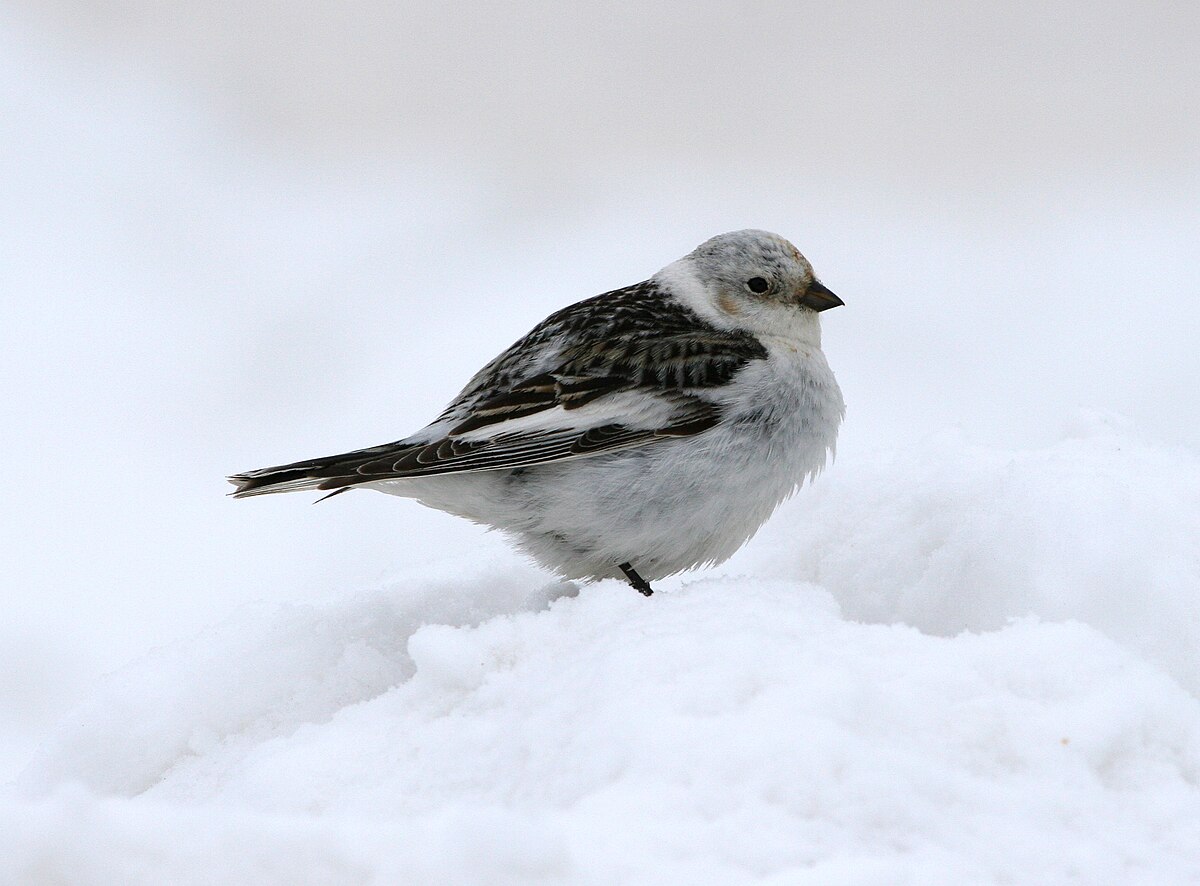
Wikipedia: Snow bunting Source: WIKIPEDIA
1200px-Plectrophenax_nivalis1.jpg
🔍
Never observed (yet!)
Description
Geography: This bird appears across the great seas in the following continents: Europe, North America.General: Deutschland: Wintergast
Seasonal behavior
Seldom seen here Presence: 02-01 - 12-16 Migration in: 11-26 - 12-16 Migration out: 11-26 - 12-03More details at Vogelwarte.ch
Other Details
Physical details
Physical details: length=16-17 cm, wingspan=32-38 cm, weight=28-50 gDetails
Profile Wikipedia Vogelwarte BirdLife ZH ornitho.ch bird-song.ch Xeno-Canto BirdID NABU YouTube
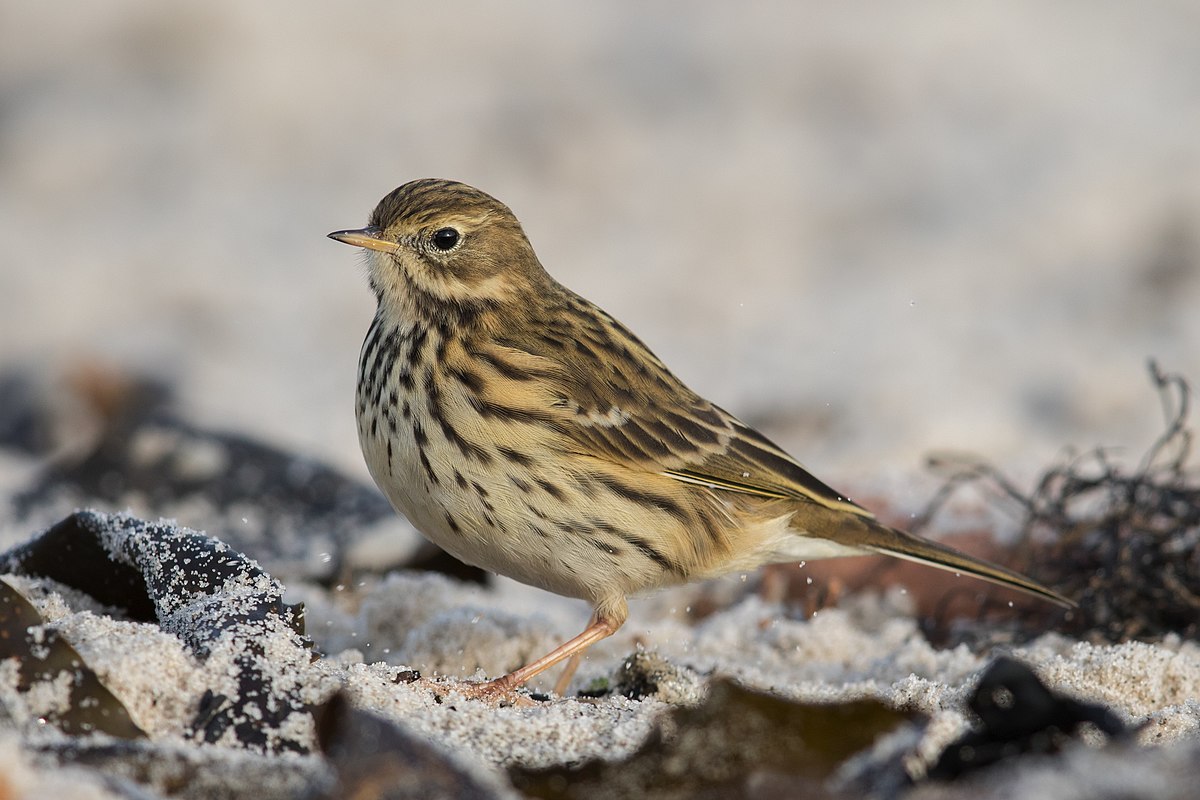
Wikipedia: Meadow pipit Source: WIKIPEDIA
1200px-Wiesenpieper_Meadow_pipit.jpg
First observed in 🇨🇭 on 2021-06-27.
Description
General: Looks like MisteldrosselGeneral: Deutschland: Brut, Zugvogel, Wintergast RL V
Etymology:
[9] The name "pipit", first documented by Thomas Pennant in 1768, is onomatopoeic, from the call note of this species. [Link]
Seasonal Behavior:
Meadow Pipits can often be observed in large numbers when they gather on fields during migration. They like to stay in meadows with high grass or on arable land and only fly up when disturbed or when a bird of prey appears, which is why they are often overlooked. [Link]
Seasonal behavior
Year-round bird Breeding: 04-01 - 07-29 Migration in: 02-20 - 05-10 Migration out: 09-17 - 11-06More details at Vogelwarte.ch
Other Details
Physical details
Physical details: length=14 cm, wingspan=22-25 cm, weight=15-22 gHabitats: Mountain
Similar species
Looks similar to: Mistle thrush.Vocalisation
Song: Single note, possibly rising at the end. (Or: long 4 second phrases, gradually louder then softer; swoopy or whoopy.) Sings in flight. BirdID: Song very similar to Rock Pipit, but tone less full and more brittle. Lacks Rock Pipit's closing trill, and beginning is less "hammering". - but what does a rock pipit sound like? Song: Ähnlich Baumpieper, aber ohne Zia-Rufe. Vollständiger Gesang nur in flatterndem Singflug. Lange Strophen. Mittelstück meist zart und hoch [Link]
Song very similar to Rock Pipit, but tone less full and more brittle. Lacks Rock Pipit's closing trill, and beginning is less "hammering". [Link]
Song attributes:
Melody: one note, fast, Frequency: medium (1-5 KHz)
Ähnlich Baumpieper, aber ohne Zia-Rufe. Vollständiger Gesang nur in flatterndem Singflug. Lange Strophen. Mittelstück meist zart und hoch [Link]
Song very similar to Rock Pipit, but tone less full and more brittle. Lacks Rock Pipit's closing trill, and beginning is less "hammering". [Link]
Song attributes:
Melody: one note, fast, Frequency: medium (1-5 KHz)
♫ Source: XENOCANTO XC722919 - Meadow Pipit - Anthus pratensis - song.mp3 (song)
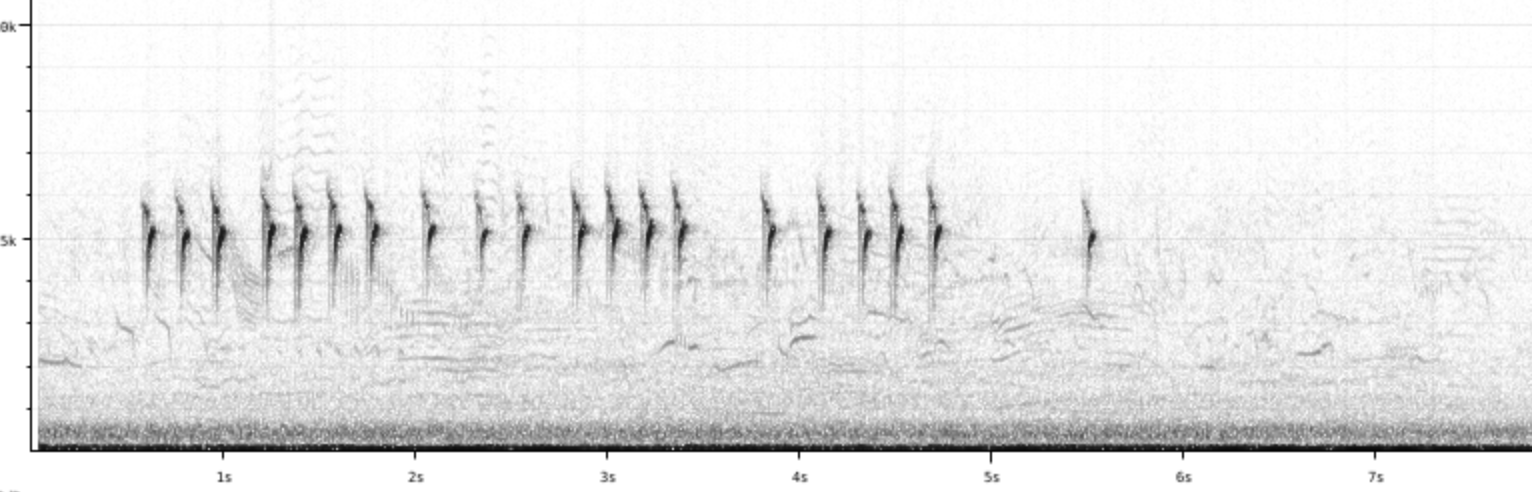
Calls:
fast tonlos „ist, ist.“
[Link]
Contact call a short "eest". Similar to Rock Pipit but shorter,cleaner and most often in quick series. Warning call a sharp, high pitched "tzeet". Also a rattling "trrrrt". [Link]
No details but a Xeno-Canto recording.
XC930459 - Meadow Pipit flight call - Anthus pratensis.
♫ Source: XENOCANTO XC930459 - Meadow Pipit flight call - Anthus pratensis.mp3 (flight call)

Call attributes: flight call Frequency: ,
Details
Profile Wikipedia Vogelwarte BirdLife ZH ornitho.ch bird-song.ch Audubon AllAboutBirds Xeno-Canto BirdID NABU YouTube

Bachstelze. 2024-05-16 11:54:46 Kaltbrunner-Riet
First observed in Iceland on 2015-06-05.
Description
Geography: This bird appears across the great seas in the following continents: Europe, North America, Africa, Asia.General:
The white wagtail (Motacilla alba) is a small passerine bird in the family Motacillidae, which also includes pipits and longclaws. The species breeds in much of Europe and the Asian Palearctic and parts of North Africa. It has a toehold in Alaska as a scarce breeder. It is resident in the mildest parts of its range, but otherwise migrates to Africa. In Ireland and Great Britain, the darker subspecies, the pied wagtail or water wagtail[2] (M. a. yarrellii) predominates. In total, there are between 9 and 11 subspecies.
[more]
Deutschland: Brut-, Zugvogel
Seasonal behavior
Other Details
Physical details
Physical details: length=18 cm, wingspan=25-30 cm, weight=17-25 gHabitats: Settlement Interesting behavior: Wags its tail when calling.
Vocalisation
Song: General: Usually just calls. This song is just a few chirpy slurs, sometimes rising-rising-falling.Song:
Zirpt wie ein Sperling aber weniger Noten. Lh lh lh [Link]
Song: Song either slow and primitive, consisting of sharp falling notes given by perched birds, or longer fast and energic bursts in excited song-flight. [Link]
Song attributes:
Mnemnoic: Plaetschert wie ein Bach Melody: stereotype melodic, slow, Frequency: 2-7 KHz
♫ Source: XENOCANTO XC694995 - White Wagtail - Motacilla alba - song recorded in Spain.mp3 Spain (song)

Calls:
Contact calls short and sharp. Usually with disyllabic, "bouncing" quality, and with each syllable only accented, not clearly separated from the other (see Grey Wagtail). [Link]
bird-song.ch: zweisilbig «zilipp» oder einsilbig «zipp»
XC644775 - White Wagtail - Motacilla alba alba - call, recorded in Estonia.
♫ Source: XENOCANTO XC644775 - White Wagtail - Motacilla alba alba - call, recorded in Estonia.mp3 (call)

Call attributes: Call melody: one note, slow, Frequency: 3-7 KHz,
Details
Common starling / Star (Sturnus vulgaris)

Junger Star sitzt auf einem Highland Cattle bei Speck, Fehraltorf. 2022-08-17 14:44:56 Fehraltorf
First observed in 🇨🇭 on 2020-04-11.
Description
Geography: This bird appears across the great seas in the following continents: Europe, North America (introduced), Africa, Asia.General: Learned on BBC's Winterwatch: the movement of a swarm of starlings is called a murmuration! Check out this this video or even an entire half hour
General: In trees or in the fields by the cows.
General: Deutschland: Brut-, Jahres-, Zugvogel RL 3[8]
Personal notes: Frequently seen here, for instance by their nests under the eaves of one of the Toblerone houses. Introduced to North America from Europe by Eugene Schieffelin.
Vocalization: Eine der Vogelarten, die gleichzeitig zwei Töne singen kann!
Vocalization:
Among the best of imitators. Mimics birds, animals and mechanical noises. Often makes several sounds at the same time. [Link]
Seasonal behavior
Year-round bird Breeding: 04-01 - 07-20 Migration in: 01-21 - 04-11 Migration out: 09-07 - 11-26More details at Vogelwarte.ch
Other Details
Physical details
Physical details: length=21 cm, wingspan=37-42 cm, weight=60-90 gHabitats: Agricultural
Vocalisation
Song: I find their individual song amusing, with its (long) whoops and weird noises. As a group, they're just noisy! Song:Song a highly varied mix of falling whistles, bill-clappering and various masterful mimicry. [Link]
Song attributes:
Melody: improvised melodic, slow, Frequency: medium (1-5 KHz) Special sounds: whoop, mimicry, weird Singing season: 01-01 - 09-30 Dawn chorus start: 15 minutes before dawn.
Calls:
Other calls; a harsh "chaee" and a short sharp "tink". [Link]
I hear this occasionally and really enjoy it - a long rising 'whoop', as I call it', starting low at 1 1/2 KHz and rising to 6 1/2 KHz!
Birdnet 1968 - European Starling long whoop call - 2021-08-23 17-26-09 - European Starling - Fehraltorf.
♫ 2021-08-23 17:26:09 Source: BirdNet 20210823_172609 birdnet 1968 - European Starling long whoop call - 2021-08-23 17-26-09 - European Starling - Fehraltorf.mp3 Fehraltorf (call)
Call attributes: Call melody: one note, slow, Frequency: 1-6 KHz, Special sounds: whoop.
Details
Redwing / Rotdrossel (Turdus iliacus)
Profile Wikipedia Vogelwarte BirdLife ZH ornitho.ch bird-song.ch Xeno-Canto BirdID NABU YouTube

Wieder mal ein Rotdrossel bei Wildert, auf der Flucht vom kalten Norden. 2025-10-31 16:07:48 Wildert
First observed in Iceland on 2015-06-05.
Description
General: In Switzerland these are migrants or winter guests that breed in Scandinavia. I saw a group that landed in a tree by the Luppmen. Some sang an odd song that I didn't recognize but unfortunately couldn't record. They were rather nervous and quickly flew off.General: I had an interesting educational experience with fieldfares! At the end of December 2020 I saw redwings in Fehraltorf for the first time. They're a winter guest that breeds in Scandinavia. Jan 2021 I saw one from our dining room window, and two days later saw 31 of them land in four trees along the Luppmen brook, and spontaneously decided to report them via the eBird app. The next day I got an automated response saying this was an unusually high number, and that I should document the sighting further. I added pictures of the group in the trees pus one of an individual close up. Then I got a nice e-mail from eBird volunteer Raphaël Nussbaumer, an Earth Science PhD and postdoc at the Swiss Ornithological Institute, saying that my redwings were fieldfares. I checked the guide books and apps, and that seemed plausible. I was surprised that none of them mentioned the danger of confusing the two, which are actually quite similar (and related). I checked the closeup I took on December 31 and asked Raphaël if it was actually a redwing, and he confirmed it. So I actually found two (to me) new thrushes within 3 weeks. He noted 'they are often found mixed with fieldfare or mistle thrush, so one has to be careful to check the entire group and not assume that all are redwings. I saw 8 similar looking birds when I saw the actual redwing, and while I think there's more than one redwing there, I can't see the whole flock well enough to be sure.
General: Deutschland: Brut-, Zugvogel, Wintergast
Appearance and identification:
Vogelwarte.ch describes just what I saw. In translation, somewhat smaller than a song thrush and distinguishable from them by the prominent white stripe above the eye and the rust-red feathers under the wings. [Link]
Seasonal Behavior:
'Regelmässiger Durchzügler, regelmässiger Wintergast', darum nur im Winter in Fehraltorf [Link]
Vocalization:
First a simple, melodic phrase of 3 - 6 notes, usually followed by a more silent, indistinct, fast and less melodic, chattering sequence. First part highly variable from place to place, but constant in individuals. Often causes confusion when a new dialect is heard at a distance, since only the first part is far-reaching, and the diagnostic two-part structure gets lost. [Link]
Seasonal behavior
Year-round bird Migration in: 02-10 - 04-20 Migration out: 09-17 - 12-07More details at Vogelwarte.ch
Other Details
Physical details
Physical details: length=21 cm, wingspan=33-34 cm, weight=50-75 gHabitats: Forest
Vocalisation
Song:Song delivered in two parts. First a simple, melodic phrase of 3 - 6 notes, usually followed by a more silent, indistinct, fast and less melodic, chattering sequence. First part highly variable from place to place, but constant in individuals. [Link]
Song: Song delivered in two parts. [Link]
Song attributes:
Mnemnoic: down 6+chattering Melody: stereotype melodic, slow, Frequency: 3-5 KHz
♫ Source: XENOCANTO XC320315 - Redwing - Turdus iliacus.mp3 (song)

Calls:
Contact call a thin, drawn and sharp "sreee". Often heard at night during migration. Alarm call harder, dryer and more raucous than other thrushes. [Link]
No details but a Xeno-Canto recording.
XC678455 - Redwing - Turdus iliacus - single call.
♫ Source: XENOCANTO XC678455 - Redwing - Turdus iliacus - single call.mp3 (call)

Call attributes: song Frequency: ,
Details
Fieldfare / Wacholderdrossel (Turdus pilaris)

Wacholderdrossel in Sils-Maria. 2023-02-06 12:34:08 Sils
First observed in 🇨🇭 on 2021-01-16.
Description
General: Deutschland: Brut-, Jahres-, Zugvogel, WintergastPersonal notes: I had an interesting educational experience with fieldfares! Check it out under Redwing.
Appearance and identification:
The fieldfare is 25 cm (10 in) long, with a grey crown, neck and rump, a plain brown back, dark wings and tail and white underwings. [Link]
Geography: Nabu: 'Die ursprüngliche Heimat dieser nordischen Drossel ist die Sibirische Taiga. Vor etwa 200 Jahren begann ihre Ausbreitung in den südwestlichen Raum Europas.'Wie der Misteldrossel vertreibt der Wacholderdrossel Feinde wie Elster, Rabenkrähe oder Bussard vom Nestgebiet mit Kotbomben. ['Die Wacholderdrossel - Turdus pilaris Ein Wintergast wird heimisch', von Paul Laakmann aus Buntspecht 3/1986]
Behavior:
 Misteldrossel greifen Vögel an die ihr Nest bedrohen könnten.
Das nennt man eine Kopropolemische Reaktion - vom griechischen für Kot under Krieg.
Mester meint Hauptziel der Angriffe wäre meistens der Kopf.
Woanders wurde erwahnt, dass der Kot der Misteldrosseln besonders klebrig ist,
eben weil der Vogel viele Mistelbeeren frisst, und wenn die Feder zusammenkleben,
könnt das Opfer nicht optimal fliegen. [Artikel 'Defensive Defäkation in der Vogelwelt' von Horst Mester, erschienen Oktober 1976 in 'Der Ornithologische Beobachter']
Misteldrossel greifen Vögel an die ihr Nest bedrohen könnten.
Das nennt man eine Kopropolemische Reaktion - vom griechischen für Kot under Krieg.
Mester meint Hauptziel der Angriffe wäre meistens der Kopf.
Woanders wurde erwahnt, dass der Kot der Misteldrosseln besonders klebrig ist,
eben weil der Vogel viele Mistelbeeren frisst, und wenn die Feder zusammenkleben,
könnt das Opfer nicht optimal fliegen. [Artikel 'Defensive Defäkation in der Vogelwelt' von Horst Mester, erschienen Oktober 1976 in 'Der Ornithologische Beobachter']
Vocalization:
Very vocal. [Link]
Seasonal behavior
Year-round bird Breeding: 04-01 - 07-20 Migration in: 03-01 - 04-20 Migration out: 09-28 - 12-16More details at Vogelwarte.ch
Other Details
Physical details
Physical details: length=25 cm, wingspan=39-42 cm, weight=80-120 gHabitats: Forest
Vocalisation
Song: BirdID says song a mix of dry contact calls, BirdLife that it's almost only heard in flight. The XC recording is a bit of a chuckle to me. Song:Gesang nicht melodisch,aus gepressten, quietschenden Tönen bestehend, fast nur im Flug vorgetragen.
[Link]
Song a mix of dry contact calls; "trrrt trrrrt", and high pitched, drawn out, chattering improvisations. [Link]
Song attributes:
Melody: non-musical (lll lll h), slow, Frequency: 1-6 KHz Special sounds: rasp
♫ Source: XENOCANTO XC769296 - Fieldfare - Turdus pilaris - song, a series of contactcalls.mp3 (song)

Calls:
Schackernd, ähnlich obiger Art [Misteldrossel], aber weicher. Am Brutplatz raue krächzende Rufe.
[Link]
Scolding call a hard "check", often given in decelerating series. Contact call in migration a soft, pleasant but, buzzy "weet". Typically bursts into continuos, squeaky chattering at takeoff. [Link]
1:
No details but a Xeno-Canto recording.
XC938835 - Fieldfare flight call - Turdus pilaris.
♫ Source: XENOCANTO XC938835 - Fieldfare flight call - Turdus pilaris.mp3 (flight call)
 Fieldfare flight call.
♫ 2025-05-14 16:16:00 Switzerland (flight call)
2: No details but a Xeno-Canto recording.
XC937607 - Fieldfare alarm call - Turdus pilaris.
♫ Source: XENOCANTO XC937607 - Fieldfare alarm call - Turdus pilaris.mp3 (alarm call)

Call attributes: flight call Frequency: ,
Details
Common blackbird / Amsel (Turdus merula)

Wunderschöner junge Amsel. 2024-05-29 07:27:36 Levanto
First observed in Australia on 2008-01-01.
Description
General: The first bird I loved listening toGeneral: It earned its own song on my album i.e.: Blackbird on a Palm Tree.
General: Deutschland: Brut-, Jahres-, Zugvogel, Wintergast
Seasonal behavior
Year-round birdOther Details
Physical details
Physical details: length=24-25 cm, wingspan=34-38 cm, weight=80-125 gHabitats: Settlement Interesting behavior: Flaps its wings when calling.
Vocalisation
Song: Other: Gut zu erkennen ist die Amsel. Sie singt melodiös, erklärt Heller, «zuerst flötend und dann gegen Schluss so schnirpslig». Die Amsel singe gerne dort, wo sie gut gehört werde, etwa vor Hauswänden, die den Schall nicht schlucken. Ich wollte schauen was schnirpslig heisst, aber diese ist diese einzige Verwendung, die Google kennt! Der flötende Teil ist relativ tief, 1.5-3 KHz, der schnirpslige aber 2.5-7 KHz. (Schnirpslig ist ein schones Wort das der Redner erfunden hat - Google findet nur diese eine Webseite mit dem Wort!) [Von der SRF Webseite:] Song:Melodisch flötend dazwischen auch zerquetschte Töne. Die Elemente werden nicht wiederholt. Singt von Singwarte aus. Ca. 100 verschiedene Strophentypen.
[Link]
One of the most appreciated song birds. Very melodious and resonant, with long mellow notes and a large register. Less high pitched sounds than Song Thrush, and seldom repeats a phrase. Timbre fuller than both Song Thrush and Mistle Thrush. Well defined pauses between phrases, giving the song a relaxed pace. [Link]
Song attributes:
Melody: improvised melodic (lmh), slow, Frequency: 1-7 KHz Special sounds: flourish Singing season: 02-01 - 07-31 Dawn chorus start: 45 minutes before dawn.
♫ 2023-02-23 17:40:48
Source: Zoom H6/H2n (song)♫ 2024-05-15 05:27:28
Source: Zoom H6/H2n Luppmen (song)Calls:
Je nach Situation, „duck duck duck“, „tix-tix-tix“ in rascher Folge, „srieh“ (auch als Flugwarnruf)
[Link]
Large repertoire of calls. Most characteristic is a hysterical rattle often given when flushed. Sometimes preceded by a hard "tok tok", which then accelerates into a panicky arpeggio-like crescendo. Contact call a thin redwing-like "srrreee". Alarm calls: a sharp "tink, tink" or a very high pitch falling whistle. [Link]
1:
Sharp-edged call, mostly one note.
XC919083 - Common Blackbird - Turdus merula - 1-note alarm call in Estonia.
♫ Source: XENOCANTO XC919083 - Common Blackbird - Turdus merula - 1-note alarm call in Estonia.mp3 (alarm call)
 Alarm rattle
♫ Had never heard something like this, but I saw a black bird land in a tree by the Luppmen and shortly thereafter a blackbird started singing, so I check xeno-canto for something similar. Sometimes called an alarm rattle. Source: XENOCANTO XC557335 common blackbird alarm call.mp3 (alarm call)
 XC931182 - Common Blackbird - Turdus merula - alarm call swoop from Sweden.
♫ Source: XENOCANTO XC931182 - Common Blackbird - Turdus merula - alarm call swoop from Sweden.mp3 (alarm call)
2: Loud falling series of notes, unlike anything else you hear from a blackbird, sometimes called an alarm rattle
Call attributes: alarm call Call melody: one note, slow, Frequency: medium (1-5 KHz),
Details
Northern wheatear / Steinschmätzer (Oenanthe oenanthe)
Profile Wikipedia Vogelwarte BirdLife ZH ornitho.ch Audubon AllAboutBirds Xeno-Canto NABU YouTube

Male northern wheatear, photo by Andreas Trepte - Own work, CC BY-SA 2.5 Source: WIKIPEDIA
Wikimedia Steinschmaetzer_Northern_wheatear_male.jpg
First observed in 🇨🇭 on 2021-07-29.
Description
Geography: This bird appears across the great seas in the following continents: Europe, North America, Africa, Asia.General: I thought after seeing these at over 2700 meters that they must be a typical mountain bird (and in the FOK Zurich materials they were in the mountain section), however Wikipedia explains that such a stony landscape is the key, whether that is high or not:
Geography:
The northern wheatear is a migratory insectivorous species breeding in open stony country in Europe and east across the Palearctic with footholds in northeastern Canada and Greenland as well as in northwestern Canada and Alaska. It nests in rock crevices and rabbit burrows. All birds spend most of their winter in Africa. ... Miniature tracking devices have recently shown that the northern wheatear has one of the longest migratory flights known - 30,000 km (18,640 miles), from sub-Saharan Africa to their Arctic breeding grounds.[15] [Link]Strangely the residence and migration maps differ greatly by source: in Wikipedia the northern wheatear spends winter in subsaharan Africa, while the authoratitive Kosmos-Vogelführer shows some in northern Africa like Morocco. Most other sources agree with Wikipedia and Sub-Saharan Africa.
General: Deutschland: Brut-, Zugvogel RL 1
Etymology: I thought the German name Steinschmätzer, presumably stone kisser (no one explains it, oddly enough) to be much more logical than the English northern wheatear. I was greatly amused to look it up and find it to be a 'folk etymology of "white" and "arse"' (Wikipedia).
Etymology:
The genus name Oenanthe is derived from the Greek oenos (οίνος) "wine" and anthos (ανθός) "flower". It refers to the northern wheatear's return to Greece in the spring just as the grapevines blossom. [Link]
Appearance and identification: It has an evil-looking black eye stripe like the shrike. (I liked Nici Baiker's description of it in the FOK field ornithology course as 'Zorro look'.) I saw one flying on Muottas Muragl and thought the striking gray oval surrounded by dark feathers has to be typical and seems unique to the northern wheatear.
Geography: In den FOK Unterlagen werden die Zugrouten von Alaska und von nordosten Kanada gezeigt, die beide für Winter nach Afrika ziehen. Die aus Alaska fliegen über Asien unglaubliche 15000 Kilometer! Die in Kanada haben es auch nicht leicht, da sie zuerst über den Atlantik nach Spanien fliegen!
Behavior:
Herbert Steffny schreibt auch jetzt Anfang Mai wo die Neuntöter aus Afrika zureuckgekehrt sind, muss man nicht früh aufstehen um sie zu beobachten, weil sie selber warten bis es warm genug ist für die (leckeren) Insekten aktiv zu werden! [Link]
Vocalization:
Each phrase is often introduced by the "weet" sound, then followed by hastened, creaking, rattling and warbling sounds of 1-2 seconds duration. [Link]
Seasonal behavior
Presence: 03-23 - 10-27 Breeding: 05-10 - 08-09 Migration in: 03-23 - 05-31 Migration out: 08-09 - 10-27More details at Vogelwarte.ch
Other Details
Physical details
Physical details: length=14-15 cm, wingspan=26-32 cm, weight=18-29 gHabitats: Mountain
Similar species
Looks similar to: Red-backed shrike.Vocalisation
Song:The Wheatear song consists of short phrases with marked pauses. Each phrase is often introduced by the "weet" sound, then followed by hastened, creaking, rattling and warbling sounds of 1-2 seconds duration. The "check" sound is also often included in the song. [Link]
General: I thought after seeing these at over 2700 meters that they must be a typical mountain bird (and in the FOK Zurich materials they were in the mountain section), however Wikipedia explains that such a stony landscape is the key, whether that is high or not: Geography:
The northern wheatear is a migratory insectivorous species breeding in open stony country in Europe and east across the Palearctic with footholds in northeastern Canada and Greenland as well as in northwestern Canada and Alaska. It nests in rock crevices and rabbit burrows. All birds spend most of their winter in Africa. ... Miniature tracking devices have recently shown that the northern wheatear has one of the longest migratory flights known - 30,000 km (18,640 miles), from sub-Saharan Africa to their Arctic breeding grounds.[15] [Link]Strangely the residence and migration maps differ greatly by source: in Wikipedia the northern wheatear spends winter in subsaharan Africa, while the authoratitive Kosmos-Vogelführer shows some in northern Africa like Morocco. Most other sources agree with Wikipedia and Sub-Saharan Africa.
Song:
Kurze, wechselvolle Strophe mit vielen unreinen Tönen. Meist von erhöhter Warte aus oder in kurzem Singflug vorgetragen.
[Link]
The Wheatear song consists of short phrases with marked pauses. The "check" sound is also often included in the song. [Link]
Song attributes:
Melody: improvised melodic, fast, Frequency: 2-6 KHz Special sounds: rasp, rattle
♫ Source: XENOCANTO XC730221 - Northern Wheatear - Oenanthe oenanthe - song recorded in France, just 2-3 notes, then long pause.mp3 (song)

♫ Source: XENOCANTO XC764932 - Northern Wheatear - Oenanthe oenanthe - song recorded in Sweden with lots of whoops and swoops, about 2 seconds long, then 3-4 seconds pause.mp3 (song)

♫ Source: XENOCANTO XC319898 - Northern Wheatear - Oenanthe oenanthe - song recorded in Scotland and includes creaking or rattling mentioned at Nord U BirdID.mp3 Scotland (song)

♫ Source: XENOCANTO XC769228 - Northern Wheatear - Oenanthe oenanthe - song recorded in the Netherlands.mp3 (song)

Details

Zaunkönig im Garten am Bodensee. 2024-01-01 13:32:24 Güttingen
First observed in 🇨🇭 on 2019-07-07.
Description
General: The third smallest bird in Switzerland, after the goldcrest and firecrestGeneral: Deutschland: Brut-, Jahres-, Zugvogel, Wintergast
Etymology:
The scientific name is taken from the Greek word "troglodytes" (from trogle a hole, and dyein to creep), meaning "cave-dweller",[4] and refers to its habit of disappearing into cavities or crevices whilst hunting arthropods or to roost. [Link]
Seasonal behavior
Year-round bird Breeding: 04-11 - 08-18 Migration in: 03-01 - 04-20 Migration out: 08-29 - 11-06More details at Vogelwarte.ch
Other Details
Physical details
Physical details: length=9-10 cm, wingspan=13-17 cm, weight=7-12 gHabitats: Forest
Vocalisation
Song: High-pitched, melodic, very variable with many trills and whistles. At least 3 seconds long, switching low to high 6 times or more, always a trill in the mix.Der deutsche Kalendar für 2025 sagt, sie könnten ab Drei-Königs-Tag singen, d.h. ab 6. Januar. nabu.de sagt ab 1. Februar, Drei-Königs-Tag ist eventuell nur wegen dem Namen Zaunkönig? Song:
Auffällig laut für den kleinen Vogel. Singt auch im Winter! Schmetternd, mit einem bis zwei Trillern als letztes oder vorletztes Glied.
[Link]
Song surprisingly loud. A high-pitched stream of clear notes resembling Robin and Dunnock in timbre. Differs from those in showing frequent shifts in pitch with much larger register than Dunnock, and by the unique, numerous, interspersed long trills. [Link]
Song attributes:
Melody: improvised melodic, fast, Frequency: high (3-9 KHz) Special sounds: trill Singing season: 02-01 - 07-31 Dawn chorus start: 60 minutes before dawn.
♫ Source: XENOCANTO XC916662 - Eurasian Wren song in China - Troglodytes troglodytes.mp3 (song)

Calls:
„zerr“ (z-und rr-gleichzeitig) auch durchdringendes „tzr“(Gezetter)
[Link]
Warning call a short hard "teck", like banging two rocks together. Often repeated in series when excited to form machine-gun-like "firing". [Link]
Sputtery/drippy/trilly repeated notes at 3-8 KHz. June 2022 heard check calls that were distinctly irregularly in their rhythm.
XC195946 - Eurasian Wren call - Troglodytes troglodytes.
♫ Source: XENOCANTO XC195946 - Eurasian Wren call - Troglodytes troglodytes.mp3 (call)

Call attributes: Call melody: one note, slow, Frequency: 3-8 KHz, Special sounds: sputter/pebble-clatter.
Details

EIn Kolkrabe wollte anscheinend etwas zum Fressen von uns. 2024-09-14 12:18:14 Fanel/Chablais de Cudrefin und La Sauge
First observed in 🇨🇭 on 2021-03-10.
Description
Geography: This bird appears across the great seas in the following continents: Europe, North America, Africa.General: The raven is often mentioned in word puzzles as the largest songbird.
General: Deutschland: Brut-, Jahresvogel
Good to know: A flock of ravens may be called an unkindness [Literary names of groups and flocks]
Etymology:
Kolk, die erste Silbe seines seit dem 16. Jahrhundert bezeugten deutschen Namens, ist vermutlich lautmalerischen Ursprungs, ahmt also den Ruf des Vogels nach. [Link]
Jahrhundert bezeugten deutschen Namens, ist vermutlich lautmalerischen Ursprungs, ahmt also den Ruf des Vogels nach. [Link]
Appearance and identification:
It is one of the two largest corvids, alongside the thick-billed raven, and is possibly the heaviest passerine bird [Link]
 Ravens are larger, the size of a Red-tailed Hawk [in Switzerland a red kite, similar 'length' but only 2/3 of the huge kite wingspan]. Ravens often travel in pairs, while crows are seen in larger groups. Also, watch the bird’s tail as it flies overhead. The crow’s tail feathers are basically the same length, so when the bird spreads its tail, it opens like a fan. Ravens, however, have longer middle feathers in their tails, so their tail appears wedge-shaped when open.
Listen closely to the birds’ calls. Crows give a cawing sound. But ravens produce a lower croaking sound.
[How to Tell a Raven From a Crow]
Ravens are larger, the size of a Red-tailed Hawk [in Switzerland a red kite, similar 'length' but only 2/3 of the huge kite wingspan]. Ravens often travel in pairs, while crows are seen in larger groups. Also, watch the bird’s tail as it flies overhead. The crow’s tail feathers are basically the same length, so when the bird spreads its tail, it opens like a fan. Ravens, however, have longer middle feathers in their tails, so their tail appears wedge-shaped when open.
Listen closely to the birds’ calls. Crows give a cawing sound. But ravens produce a lower croaking sound.
[How to Tell a Raven From a Crow]
Vocalization:
Quite varied repertoire. Most heard sound a short, coarse, but resonant "korrk. Other sounds may be surprisingly resonant and pure, like a ringing "clong" etc. Shows even more variation when courting. [Link]
Seasonal behavior
Year-round bird Breeding: 02-20 - 06-09More details at Vogelwarte.ch
Other Details
Physical details
Physical details: length=64 cm, wingspan=120-150 cm, weight=800-1560 gHabitats: Mountain
Vocalisation
Song: No details but a Xeno-Canto recording. Song attributes: Frequency:♫ 2025-10-14 15:41:00 Switzerland (song)
Graak!
XC779842 - Northern Raven - Corvus corax corax - call recorded in Sweden.
♫ Source: XENOCANTO XC779842 - Northern Raven - Corvus corax corax - call recorded in Sweden.mp3 (call)

Call attributes: Call melody: non-musical, slow, Frequency: low (1-3 KHz), Special sounds: cawing.
Details

Fantasievolle Sturmmöwe Zürichsee, Postkarte vom Teddys Souvenir Shop, Limmatquai, Zürich. 2021-09-11 12:00:00
First observed in 🇨🇭 on 2021-02-05.
Description
Geography: This bird appears across the great seas in the following continents: Europe, North America, Africa, Asia.General: Not so common in Switzerland (most common would be the black-headed gull as far as I can see
General: Deutschland: Brut-, Jahres-, Zugvogel, Wintergast
Etymology:
[10] The original English word mew is related to German möwe and Dutch meeuw, and is ultimately onomatopoeic. [Link]
Appearance and identification: Nabu: NABU über das Aussehen der Sturmmöwe: 'Sturmmöwen sind etwas größer als Lachmöwen, jedoch deutlich kleiner als Silbermöwen. Sie sind überwiegend weiß mit grauem Rücken und grauen Flügeln. Die Flügelenden sind schwarz mit weißer Spitze. Der Kopf ist rundlich, die dunklen Augen dünn rot umrandet. Der schlanke Schnabel und die Beine sind grünlichgelb, ein Schnabelfleck fehlt.' [Porträt]
Vocalization:
Various mewing sounds. Similar in form to Herring Gull, but much higher pitched. [Link]
Seasonal behavior
Year-round bird Migration in: 01-01 - 05-10 Migration out: 10-18 - 12-31More details at Vogelwarte.ch
Other Details
Physical details
Physical details: length=40-42 cm, wingspan=100-115 cm, weight=300-480 gnot sexually dimporphic. Identifying characteristics: general: head = white (Gray in winter and when young), beak = yellow (greenish yellow), legs = yellow (duller in winter), , , , Adult: wings = gray, , , Youth: wings = white (with brown streaks), , Winter: tail = black (and white striped), Prachtkleid: tail = white Habitats: River and lake Details
Profile Wikipedia Audubon AllAboutBirds Xeno-Canto BirdID NABU YouTube

MerlinBirdID says glaucous gull and American black duck females. 2023-10-12 13:39:32 New England
First observed in New England on 2023-10-12.
Description
Geography: This bird appears across the great seas in the following continents: Europe, North America.General:
The glaucous gull (Larus hyperboreus) is a large gull, the second-largest gull in the world. It breeds in Arctic regions of the Northern Hemisphere and winters south to shores of the Holarctic. The genus name is from Latin larus, which appears to have referred to a gull or other large seabird. The specific name hyperboreus is Latin for "northern" from the Ancient Greek Huperboreoi people from the far north [2] "Glaucous" is from Latin glaucus and denotes the grey colour of the gull.[3]
[more]
Vocalization:
Like Herring Gull. [Link]
Other Details
Physical details
Physical details: length=62-68 cm, wingspan=150-165 cm, weight=964-2215 gDetails
Profile Wikipedia Vogelwarte BirdLife ZH ornitho.ch Audubon AllAboutBirds Xeno-Canto BirdID NABU YouTube

Either a lesser black-backed gull because of the orange legs, short neck, flat-topped head or yellow-legged gull because the bill is more yellow than orange. 2022-01-16 13:20:46
🔍
Never observed (yet!)
Description
Geography: This bird appears across the great seas in the following continents: Europe, North America, Africa, Asia.General: Deutschland: Brut-, Zugvogel, Wintergast
Vocalization:
Very similar to Herring Gull, but tone more nasal. [Link]
Other Details
Physical details
Physical details: length=52-64 cm, wingspan=117-134 cm, weight=620-1000 gHabitats: River and lake Details
Profile Wikipedia Vogelwarte BirdLife ZH ornitho.ch Audubon AllAboutBirds Xeno-Canto BirdID NABU YouTube
, Islay near Bridgend.JPG)
Great black-backed gull (Mantelmöwe), Islay near Bridgend. 2023-08-11 09:31:48 Islay
First observed in Islay on 2023-08-11.
Description
Geography: This bird appears across the great seas in the following continents: Europe, North America.General: Deutschland: Brut-, Jahres-, Zugvogel, Wintergast RL R
Vocalization:
Can be identified from the low pitch alone. Clearly deeper than Lesser Black-backed and Herring Gull. [Link]
Other Details
Physical details
Physical details: length=64-78 cm, wingspan=150-165 cm, weight=1033-2272 gHabitats: River and lake Details

Herring gull, near Barnegat Lighthouse, Long Beach Island, NJ. 2024-09-18 19:48:40 New Jersey
First observed in Scotland on 2023-08-19.
Description
Geography: This bird appears across the great seas in the following continents: Europe, North America, South America, Asia.General: Deutschland: Brut-, Jahres-, Zugvogel, Wintergast
Vocalization:
Quite vocal. A long and strong "ay-kay-kay-kay-kay" with fading strength commonly heard. A deep "ga-ga-ga" heard from anxious birds. [Link]
Other Details
Physical details
Physical details: length=55-64 cm, wingspan=123-148 cm, weight=750-1440 gHabitats: River and lake Details
Profile Wikipedia Audubon AllAboutBirds Xeno-Canto BirdID NABU YouTube
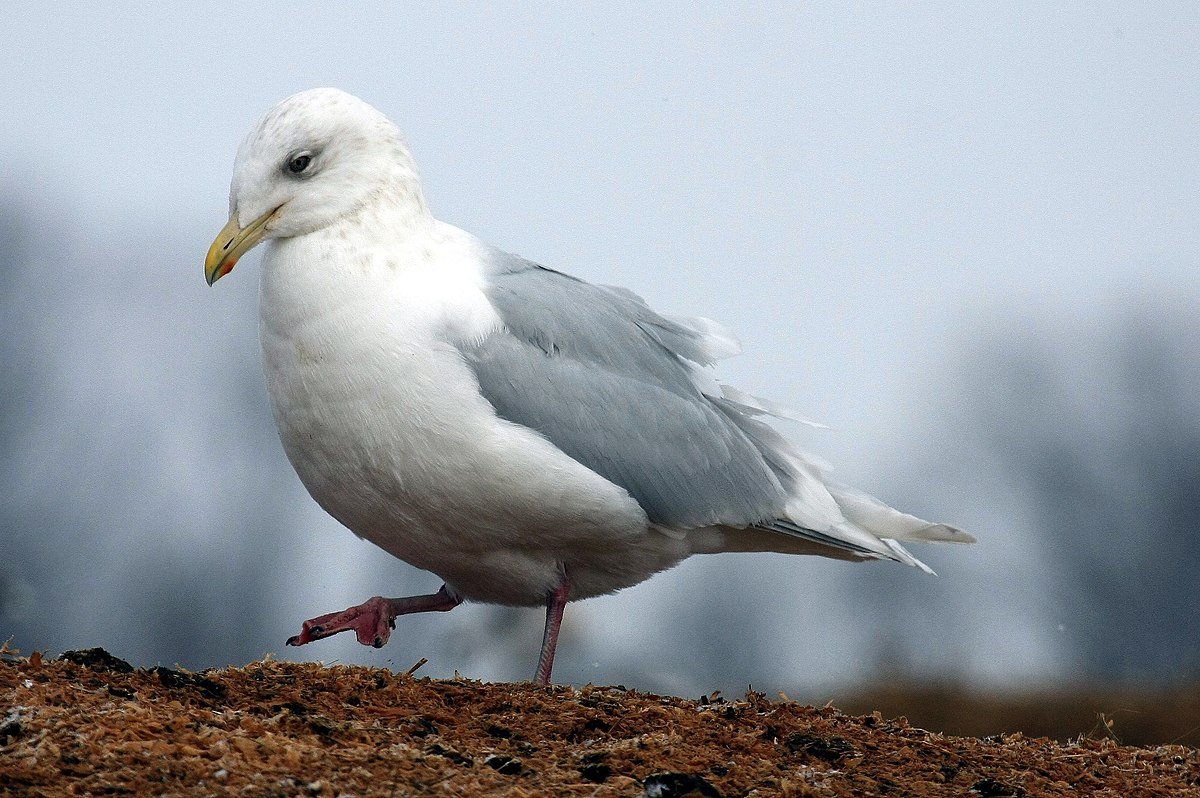
Wikipedia: Iceland gull Source: WIKIPEDIA
1200px-Larus_glaucoides_IthacaNY.jpg
🔍
Never observed (yet!)
Description
Geography: This bird appears across the great seas in the following continents: Europe, North America.General:
The Iceland gull (Larus glaucoides) is a medium-sized gull that breeds in the Arctic regions of Canada and Greenland, but not in Iceland (as its name suggests), where it is only seen during winter. The genus name is from Latin larus, which appears to have referred to a gull or other large seabird. The specific name glaucoides denotes its resemblance to Larus glaucus, a synonym of Larus hyperboreus, the glaucous gull; -oides is Ancient Greek and means "resembling".[2]
[more]
Vocalization:
Like Herring Gull, but tone sharper. [Link]
Other Details
Physical details
Physical details: length=52-60 cm, wingspan=140-150 cm, weight=460-1039 gDetails

Cormorant, Graureiher, zwei Lachmöwen am Klingnauerstausee. 2022-02-05 10:35:32 Klingnauer Stausee (man-made lake)
First observed in 🇨🇭 on 2020-05-20.
Description
Geography: This bird appears across the great seas in the following continents: Europe, North America, Africa, Asia.General: Common waterbird at Pfäffikersee, that doesn't necessarily have the eponymous black head.
General: Deutschland: Brut-, Jahres-, Zugvogel, Wintergast
Etymology:
[40], In Richard Adams' 1972 novel Watership Down, a black-headed gull named Kehaar (who claims his name is the onomatopoeia of waves breaking against the shore) plays a major part in the story. [Link]
Vocalization:
Quite vocal, especially at breeding ground. [Link]
Seasonal behavior
Year-round birdOther Details
Physical details
Physical details: length=34-37 cm, wingspan=86-99 cm, weight=200-400 gnot sexually dimporphic. No breeding plumage Identifying characteristics: Summer: head = black, , , , , tail = black Winter: head = white (With Charlie Brown-style half circle behind the eye), , , , general: beak = red, legs = red, wings = gray, Habitats: River and lake
Vocalisation
Song: No details but a Xeno-Canto recording. Song attributes: Frequency:♫ 2021-04-27 16:51:23 Source: BirdNet 20210427_165123 birdnet 1485 - Black-headed Gull racket at Chlisee - No confident detection - Wetzikon.mp3 Wetzikon (song)
Details
Black-legged kittiwake / Dreizehenmöwe (Rissa tridactyla)
Profile Wikipedia Vogelwarte BirdLife ZH ornitho.ch Audubon AllAboutBirds Xeno-Canto NABU YouTube

Wikipedia: Black-legged kittiwake Source: WIKIPEDIA
1200px-Rissa_tridactyla_%28Vard%C3%B8%2C_2012%29.jpg
🔍
Never observed (yet!)
Description
Geography: This bird appears across the great seas in the following continents: Europe, North America, Africa, Asia.General: Deutschland: Brut-, Jahres-, Zugvogel, Wintergast RL R
Vocalization:
Highly vocal at breeding ground. A mewing "kitti-wake", with the pitch rising on the second drawn out syllable, and then falling. Generally silent elsewhere, except when squabbling over food. [Link]
Seasonal behavior
Seldom seen here Year-round bird Migration in: 03-01 - 03-23 Migration out: 03-15 - 03-23More details at Vogelwarte.ch
Other Details
Physical details
Physical details: length=38-40 cm, wingspan=95-105 cm, weight=310-500 gDetails
Great auk / Riesenalk (Pinguinus impennis)
Profile Wikipedia Xeno-Canto NABU YouTube

Wikipedia: Great auk Source: WIKIPEDIA
Great_Auk_%28Pinguinis_impennis%29_specimen%2C_Kelvingrove%2C_Glasgow_-_geograph.org.uk_-_1108249.jpg
🔍
Never observed (yet!)
Description
General:The great auk (Pinguinus impennis) is a species of flightless alcid that became extinct in the mid-19th century. It was the only modern species in the genus Pinguinus. It is not closely related to the birds now known as penguins, which were discovered later and so named by sailors because of their physical resemblance to the great auk.
[more]
Details
Common ringed plover / Sandregenpfeifer (Charadrius hiaticula)
Profile Wikipedia Vogelwarte BirdLife ZH ornitho.ch Audubon AllAboutBirds Xeno-Canto BirdID NABU YouTube

Sandregenpfeifer auf Ende vom Damm in La Sauge. 2024-09-14 15:34:58 Fanel/Chablais de Cudrefin und La Sauge
First observed in 🇨🇭 on 2022-09-04.
Description
Geography: This bird appears across the great seas in the following continents: Europe, North America, Africa, Asia.General: Deutschland: Brut-, Zugvogel RL 1
Vocalization:
Usually heard before seen. [Link]
Seasonal behavior
Presence: 03-12 - 10-27 Migration in: 10-07 - 10-27 Migration out: 10-07 - 10-15More details at Vogelwarte.ch
Other Details
Physical details
Physical details: length=18-20 cm, wingspan=48-57 cm, weight=55-73 gHabitats: Wetland Details
Semipalmated plover / Amerika-Sandregenpfeifer (Charadrius semipalmatus)
Profile Wikipedia Audubon AllAboutBirds Xeno-Canto BirdID NABU YouTube

Wikipedia: Semipalmated plover Source: WIKIPEDIA
Semipalmated_Plover.jpg
🔍
Never observed (yet!)
Description
Geography: This bird appears across the great seas in the following continents: Europe, North America, South America.General:
The semipalmated plover (Charadrius semipalmatus) is a small plover. The genus name Charadrius is a Late Latin word for a yellowish bird mentioned in the fourth-century Vulgate. It derives from Ancient Greek kharadrios a bird found in ravines and river valleys (kharadra, "ravine"). The specific semipalmatus is Latin and comes from semi, "half" and palma, "palm". Like the English name, this refers to its only partly webbed feet.[2]
[more]
Details
European golden-plover / Goldregenpfeifer (Pluvialis apricaria)

Wikipedia: European golden-plover Source: WIKIPEDIA
1200px-Kul%C3%ADk_zlat%C3%BD_%28Pluvialis_apricaria%29_a_%283949776435%29.jpg
🔍
Never observed (yet!)
Description
Deutschland: Brut-, Zugvogel RL 1Seasonal behavior
Presence: 02-20 - 12-16 Migration in: 11-26 - 12-03 Migration out: 03-01 - 04-01More details at Vogelwarte.ch
Other Details
Physical details
Physical details: length=26-29 cm, wingspan=67-76 cm, weight=160-280 gHabitats: Wetland Details
Red knot / Knutt (Calidris canutus)
Profile Wikipedia Vogelwarte BirdLife ZH ornitho.ch Audubon AllAboutBirds Xeno-Canto BirdID NABU YouTube

Red knots, according to MerlinBirdID - underway to somewhere better at Las Coloradas. 2023-04-15 09:34:08 Yucatan
First observed in Yucatan on 2023-04-15.
Description
Geography: This bird appears across the great seas in the following continents: Europe, North America, South America, Africa, Asia.General: Deutschland: Zugvogel, Wintergast
Other Details
Physical details
Physical details: length=23-25 cm, wingspan=57-61 cm, weight=110-160 gHabitats: Wetland Details
Dunlin / Alpenstrandläufer (Calidris alpina)
Profile Wikipedia Vogelwarte BirdLife ZH ornitho.ch Audubon AllAboutBirds Xeno-Canto BirdID NABU YouTube
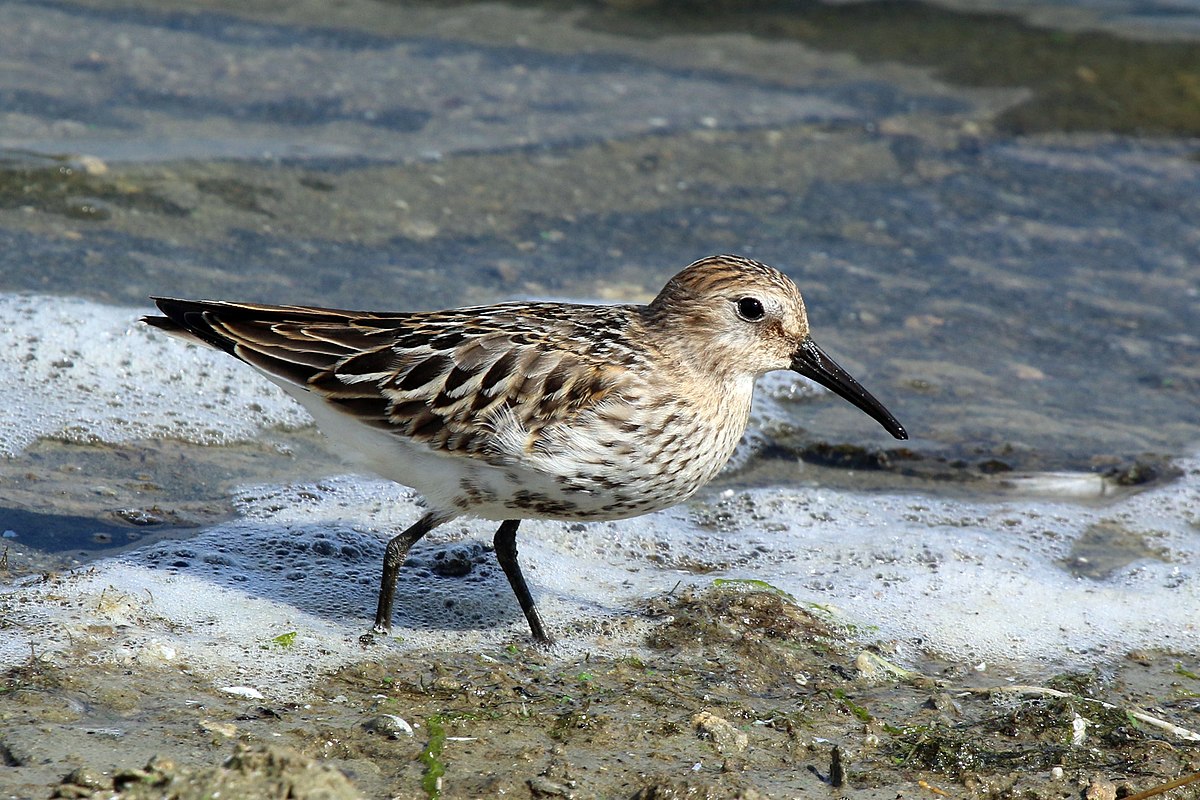
Wikipedia: Dunlin Source: WIKIPEDIA
1200px-Dunlin_%28Calidris_alpina%29_juvenile.jpg
🔍
Never observed (yet!)
Description
Geography: This bird appears across the great seas in the following continents: Europe, North America, South America, Africa, Asia.General: Deutschland: Brut-, Zugvogel, Wintergast RL 1
Seasonal behavior
Year-round bird Migration in: 03-01 - 03-23 Migration out: 03-15 - 03-23More details at Vogelwarte.ch
Other Details
Physical details
Physical details: length=16-20 cm, wingspan=38-43 cm, weight=35-60 gHabitats: Wetland Details
Sanderling / Sanderling (Calidris alba)
Profile Wikipedia Vogelwarte BirdLife ZH ornitho.ch Audubon AllAboutBirds Xeno-Canto BirdID NABU YouTube

Wahrscheinlich Sanderling - there must be a better photo. 2024-09-14 15:34:48 Fanel/Chablais de Cudrefin und La Sauge
First observed in Yucatan on 2023-03-27.
Description
Geography: This bird appears across the great seas in the following continents: Europe, North America, South America, Africa, Asia.General: Deutschland: Zugvogel, Wintergast
Seasonal behavior
Presence: 04-11 - 10-27 Migration in: 10-07 - 10-15 Migration out: 04-20 - 05-31More details at Vogelwarte.ch
Other Details
Physical details
Physical details: length=20-21 cm, wingspan=40-45 cm, weight=44-70 gHabitats: Wetland Details
Purple sandpiper / Meerstrandläufer (Calidris maritima)
Profile Wikipedia Audubon AllAboutBirds Xeno-Canto BirdID NABU YouTube
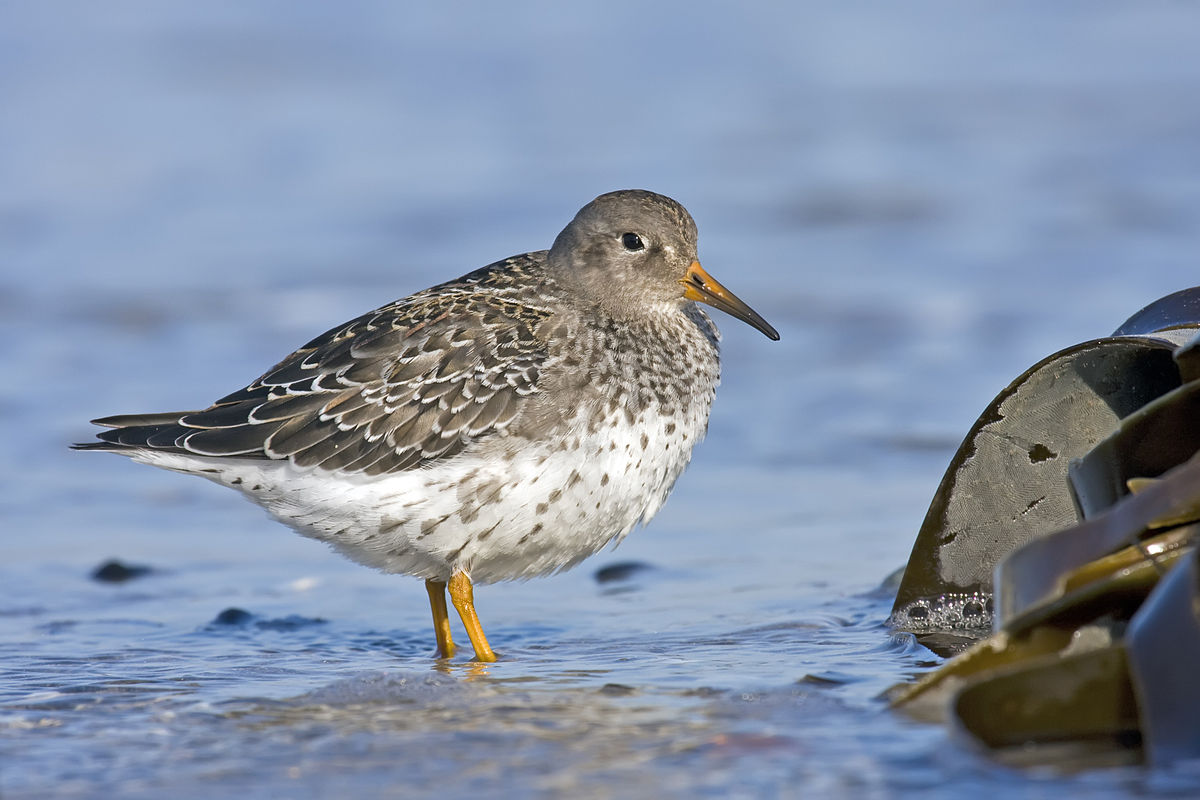
Wikipedia: Purple sandpiper Source: WIKIPEDIA
1200px-Calidris_maritima.jpg
🔍
Never observed (yet!)
Description
Geography: This bird appears across the great seas in the following continents: Europe, North America.General: Deutschland: Zugvogel, Wintergast
Other Details
Physical details
Physical details: length=20-22 cm, wingspan=42-46 cm, weight=52-80 gDetails
Temminck's stint / Temminckstrandläufer (Calidris temminckii)
Profile Wikipedia Vogelwarte BirdLife ZH ornitho.ch Xeno-Canto BirdID NABU YouTube

Wikipedia: Temminck's stint Source: WIKIPEDIA
1200px-Temmincks_Stint.jpg
🔍
Never observed (yet!)
Description
General: Deutschland: ZugvogelOther Details
Physical details
Physical details: length=13-15 cm, wingspan=34-37 cm, weight=17-30 gHabitats: Wetland Details
Whimbrel / Regenbrachvogel (Numenius phaeopus)

Whimbrel at x. 2025-02-25 10:29:04 Lanzarote
First observed in San Christiano on 2022-03-19.
Description
Geography: This bird appears across the great seas in the following continents: Europe, North America, South America, Africa, Asia.General: Deutschland: Zugvogel
Seasonal behavior
Presence: 03-23 - 10-07 Migration in: 05-10 - 05-31 Migration out: 05-10 - 05-18More details at Vogelwarte.ch
Other Details
Physical details
Physical details: length=40-42 cm, wingspan=76-89 cm, weight=300-660 gHabitats: Wetland Details
Ruddy turnstone / Steinwälzer (Arenaria interpres)

Ruddy turnstone, San Christiana, Tenerife. 2022-03-19 10:26:30
First observed in Tenerife on 2022-03-19.
Description
Geography: This bird appears across the great seas in the following continents: Europe, North America, South America, Africa, Asia.General: Deutschland: Brut-, Zugvogel, Wintergast RL 2
Seasonal behavior
Presence: 04-11 - 10-18 Migration in: 05-01 - 06-20 Migration out: 05-01 - 06-08More details at Vogelwarte.ch
Other Details
Physical details
Physical details: length=22-24 cm, wingspan=50-57 cm, weight=85-150 gHabitats: Wetland Details
Common snipe / Bekassine (Gallinago gallinago)

Wahrscheinlich Bekassine mit dem langen Schnabel, Klingnauerstausee. 2022-02-05 11:54:14 Klingnauer Stausee (man-made lake)
First observed in 🇨🇭 on 2021-10-24.
Description
Geography: This bird appears across the great seas in the following continents: Europe, North America, Africa, Asia.General:
The common snipe (Gallinago gallinago) is a small, stocky wader native to the Old World.
[more]
Deutschland: Brut-, Zugvogel, Wintergast RL 1
Vocalization:
Quite vocal, especially at breeding ground. [Link]
Seasonal behavior
Year-round bird Migration in: 01-01 - 05-21 Migration out: 07-20 - 12-31More details at Vogelwarte.ch
Other Details
Physical details
Physical details: length=25-27 cm, wingspan=44-47 cm, weight=80-140 gHabitats: Wetland
Vocalisation
Song: No details but a Xeno-Canto recording. Song:Song an unmistakable bleating, drumming sound produced by vibrating tail feathers in sky-dives. [Link]
Song attributes:
Frequency:
♫ Source: XENOCANTO XC812599 - Common Snipe song, one note, 4x per sec - Gallinago gallinago.mp3 (song)

Calls:
Almost always give diagnostic hoarse and nasal "kaaat" call when flushed. Another territorial call is a rhythmic, mechanical and sharp "tika-tika-tka", or "ika-ka-ka". [Link]
XC947581 - Common Snipe flight call - Gallinago gallinago.
♫ Source: XENOCANTO XC947581 - Common Snipe flight call - Gallinago gallinago.mp3 (flight call)

Call attributes: flight call Call melody: one note, slow, Frequency: medium (1-5 KHz), Special sounds: quack.
Details
Black-tailed godwit / Uferschnepfe (Limosa limosa)
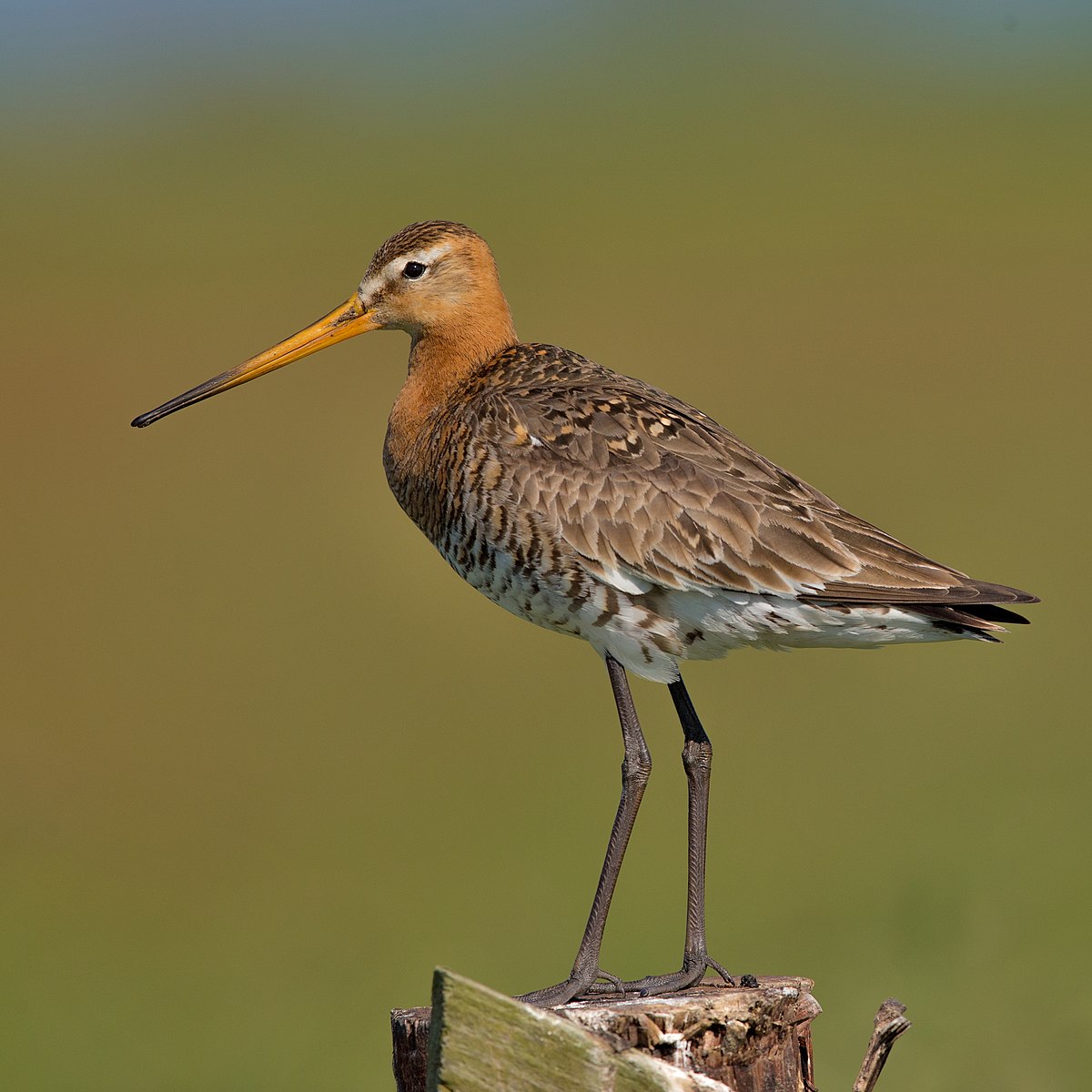
Wikipedia: Black-tailed godwit Source: WIKIPEDIA
1200px-Black-tailed_Godwit_Uferschnepfe.jpg
🔍
Never observed (yet!)
Description
Geography: This bird appears across the great seas in the following continents: Europe, North America, Africa, Asia.General: Deutschland: Brut-, Zugvogel RL 1
Vocalization:
Quite vocal at breeding ground, but mostly silent elsewhere. Varied repertoire of mewing and sharp sounds, some resembling Bar-tailed, some almost lapwing-like. [Link]
Seasonal behavior
Presence: 02-20 - 09-28 Migration in: 05-01 - 05-31 Migration out: 05-01 - 05-08More details at Vogelwarte.ch
Other Details
Physical details
Physical details: length=40-44 cm, wingspan=70-82 cm, weight=250-390 gHabitats: Wetland Details
Common redshank / Rotschenkel (Tringa totanus)
Profile Wikipedia Vogelwarte BirdLife ZH ornitho.ch Xeno-Canto BirdID NABU YouTube

Common redshank plus common pochard. 2022-04-12 14:02:38
First observed in Mallorca on 2022-04-12.
Description
General: Deutschland: Brut-, Zugvogel, Wintergast RL VVocalization:
Generally a noisy and loud bird, especially at breeding ground. Most heard is a characteristic "tew-hoo", or "tew-hoo-hoo" with first syllable accentuated. No gap between the syllables like Greenshank, and usually with a marked falling pitch. [Link]
Seasonal behavior
Presence: 03-01 - 10-07 Migration in: 03-23 - 05-21 Migration out: 03-15 - 03-23More details at Vogelwarte.ch
Other Details
Physical details
Physical details: length=27-29 cm, wingspan=59-66 cm, weight=85-150 gHabitats: Wetland Details
Red phalarope / Thorshühnchen (Phalaropus fulicarius)

Wikipedia: Red phalarope Source: WIKIPEDIA
1200px-Phalaropus_fulicarius_10.jpg
🔍
Never observed (yet!)
Description
Geography: This bird appears across the great seas in the following continents: Europe, North America, South America, Africa, Asia.General: Deutschland: seltener Zugvogel
Seasonal behavior
Seldom seen hereMore details at Vogelwarte.ch
Other Details
Physical details
Physical details: length=20-22 cm, wingspan=40-44 cm, weight=40-75 gDetails
Red-necked phalarope / Odinshühnchen (Phalaropus lobatus)
Profile Wikipedia Vogelwarte BirdLife ZH ornitho.ch Audubon AllAboutBirds Xeno-Canto BirdID NABU YouTube
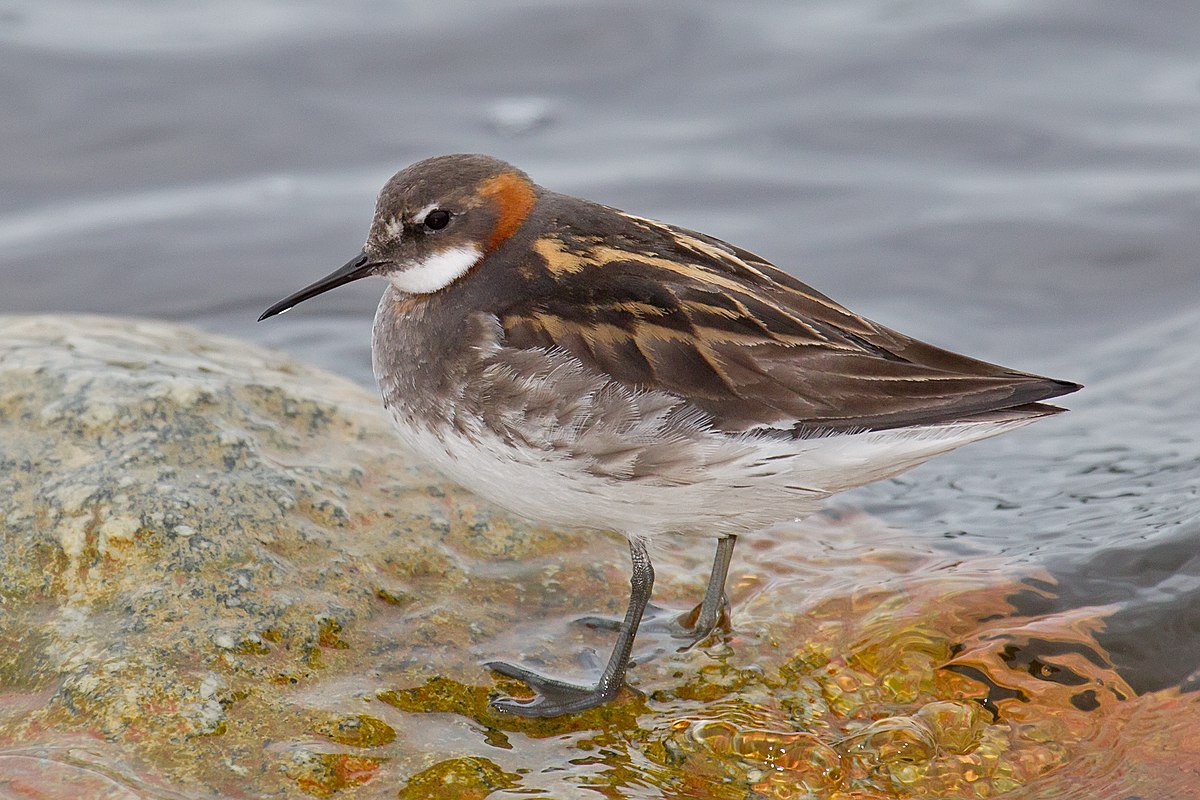
Wikipedia: Red-necked phalarope Source: WIKIPEDIA
1200px-Red-necked_Phalarope.jpg
🔍
Never observed (yet!)
Description
Geography: This bird appears across the great seas in the following continents: Europe, North America, South America, Africa, Asia.General: Deutschland: Zugvogel
Vocalization:
Short and sharp "teck", sometimes repeated to form trilling series. Also a mewing, nasal "veeoo". [Link]
Seasonal behavior
Presence: 05-21 - 10-27 Migration in: 10-07 - 10-27 Migration out: 10-07 - 10-15More details at Vogelwarte.ch
Other Details
Physical details
Physical details: length=18-19 cm, wingspan=32-41 cm, weight=27-48 gDetails
Arctic tern / Kü̈stenseeschwalbe (Sterna paradisaea)

Küstenseeschwalbe. 2026-05-26 13:09:32 Switzerland
First observed in 🇨🇭 on 2026-05-25.
Description
Geography: This bird appears across the great seas in the following continents: Europe, North America, South America, Africa, Asia.General: Deutschland: Brut-, Zugvogel RL 2
Vocalization:
Similar to Common Tern but higher pitched. [Link]
Seasonal behavior
Seldom seen hereMore details at Vogelwarte.ch
Other Details
Physical details
Physical details: length=33-35 cm, wingspan=75-85 cm, weight=95-120 gDetails
Thick-billed guillemot / Dickschnabellumme (Uria lomvia)

Wikipedia: Thick-billed guillemot Source: WIKIPEDIA
Uria_lomvia1.jpg
🔍
Never observed (yet!)
Description
Geography: This bird appears across the great seas in the following continents: Europe, North America.General:
The thick-billed murre or Brünnich's guillemot (Uria lomvia) is a bird in the auk family (Alcidae). This bird is named after the Danish zoologist Morten Thrane Brünnich. The very deeply black North Pacific subspecies Uria lomvia arra is also called Pallas' murre after its describer. The genus name is from Ancient Greek ouria, a waterbird mentioned by Athenaeus. The species term lomvia is a Swedish word for an auk or diver.[2] The English "guillemot" is from French guillemot probably derived from Guillaume, "William".[3] "Murre" is of uncertain origins, but may imitate the call of the common guillemot.[4]
[more]
Vocalization:
Coarse and deep voice, like a cross between Guillemot and Razorbill. Coarser than Guillemot but with the same laughing ending, but slower. [Link]
Other Details
Physical details
Physical details: length=39-43 cm, wingspan=65-73 cm, weight=750-1100 gDetails
Common murre / Trottellumme (Uria aalge)

Wikipedia: Common murre Source: WIKIPEDIA
1200px-Guillemots_on_Bear_Island_Svalbard_Arctic_%2819659642914%29.jpg
🔍
Never observed (yet!)
Description
Geography: This bird appears across the great seas in the following continents: Europe, North America, Africa.General: Deutschland: Brut-, Jahres-, Zugvogel, Wintergast RL R
Vocalization:
Very coarse and deep voice. [Link]
Other Details
Physical details
Physical details: length=38-41 cm, wingspan=64-70 cm, weight=490-863 gDetails
Razorbill / Tordalk (Alca torda)
Profile Wikipedia Audubon AllAboutBirds Xeno-Canto BirdID NABU YouTube
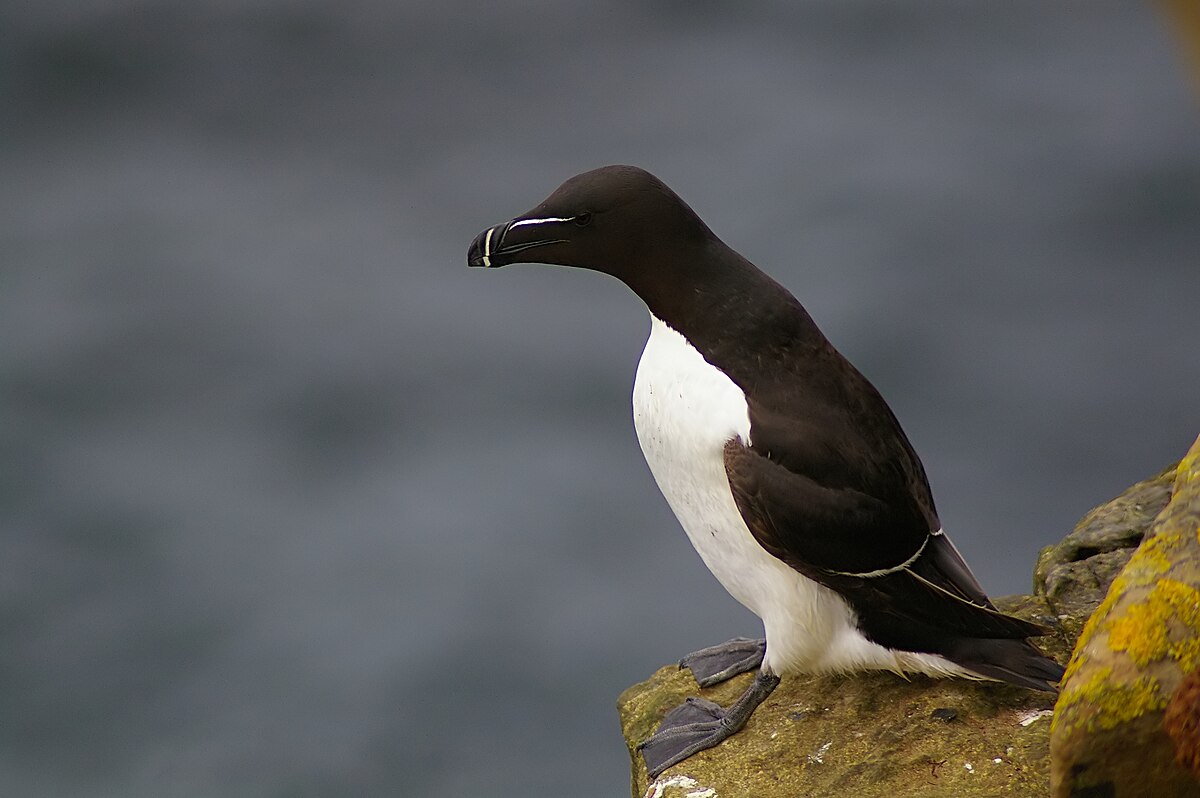
Wikipedia: Razorbill Source: WIKIPEDIA
1200px-Alca_torda_Caithness%2C_Scotland.jpg
🔍
Never observed (yet!)
Description
Geography: This bird appears across the great seas in the following continents: Europe, North America, Africa.General: Deutschland: Brut-, Jahresvogel, Wintergast RL R
Vocalization:
Very coarse and deep voice. Grunting or snore-like, with little phrasing. Mostly heard at breeding ground, but also sometimes at sea. [Link]
Other Details
Physical details
Physical details: length=37-39 cm, wingspan=63-68 cm, weight=524-890 gDetails
Dovekie / Krabbentaucher (Alle alle)

Wikipedia: Dovekie Source: WIKIPEDIA
1200px-Little_Auk_%28js%29_24.jpg
🔍
Never observed (yet!)
Description
Geography: This bird appears across the great seas in the following continents: Europe, North America.General: Deutschland: Zugvogel, Wintergast
Vocalization:
Voice higher pitched than other auks (except Black Guillemot). Trilling, rolling and chattering laughter "kreeee he he he he", or shorter, softer utterances; "ke ke" or "hup hup". [Link]
Other Details
Physical details
Physical details: length=17-19 cm, wingspan=40-48 cm, weight=140-190 gDetails
Black guillemot / Gryllteiste (Cepphus grylle)
Profile Wikipedia Audubon AllAboutBirds Xeno-Canto BirdID NABU YouTube

Wikipedia: Black guillemot Source: WIKIPEDIA
Tystie1.jpg
🔍
Never observed (yet!)
Description
Geography: This bird appears across the great seas in the following continents: Europe, North America.General: Deutschland: seltener Wintergast
Other Details
Physical details
Physical details: length=30-32 cm, wingspan=52-58 cm, weight=340-500 gDetails
Atlantic puffin / Puffin (Fratercula arctica)
Profile Wikipedia Audubon AllAboutBirds Xeno-Canto NABU YouTube

Atlantic puffin landing. 2015-06-10 15:10:10
First observed in Iceland on 2015-06-10.
Description
Geography: This bird appears across the great seas in the following continents: Europe, North America, Africa.General:
The Atlantic puffin (Fratercula arctica), also known as the common puffin, is a species of seabird in the auk family. It is the only puffin native to the Atlantic Ocean; two related species, the tufted puffin and the horned puffin, are found in the northeastern Pacific. The Atlantic puffin breeds in Québec, Iceland, Norway, Greenland, Newfoundland and Labrador, Nova Scotia and the Faroe Islands, and as far south as Maine in the west and France in the east. The Atlantic Puffin is most commonly found on the Westman Islands, Iceland. Although it has a large population and a wide range, the species has declined rapidly, at least in parts of its range, resulting in it being rated as vulnerable by the IUCN. On land, it has the typical upright stance of an auk. At sea, it swims on the surface and feeds mainly on small fish, which it catches by diving under water, using its wings for propulsion.
[more]
Vocalization:
Deep, but not so coarse as Razorbill. Smoother and more gliding changes in pitch, like a "slow-motion" laugh or distant chainsaw; "aaaahrrr, aahr, ahr arh". [Link]
Other Details
Physical details
Physical details: length=26-29 cm, wingspan=47-63 cm, weight=320-480 gDetails
Eurasian oystercatcher / Austernfischer (Haematopus ostralegus)
Profile Wikipedia Vogelwarte BirdLife ZH ornitho.ch Xeno-Canto BirdID NABU YouTube

Eurasian oystercatcher, Iceland. 2015-06-09 14:04:38
First observed in Iceland on 2015-06-09.
Description
General: Deutschland: Brut-, Jahres-, Zugvogel, WintergastEtymology: Bbc2: A flock of oyster catchers is a parcel [A nugget from Winterwatch 2022, episode 1, from BBC 2]
Vocalization:
Very vocal. [Link]
Other Details
Physical details
Physical details: length=40-45 cm, wingspan=80-86 cm, weight=430-650 gHabitats: Wetland Details
Parasitic jaeger / Schmarotzerraubmöwe (Stercorarius parasiticus)

Arctic Skua, defending its nest. 2015-06-10 14:32:52
First observed in Iceland on 2015-06-10.
Description
Geography: This bird appears across the great seas in the following continents: Europe, North America, South America, Africa, Asia.General: Deutschland: Zugvogel
Vocalization:
Mostly heard at breeding ground. [Link]
Seasonal behavior
Seldom seen hereMore details at Vogelwarte.ch
Other Details
Physical details
Physical details: length=41-46 cm, wingspan=110-125 cm, weight=330-570 gDetails
Family Burhinidae (Triele, Haematopodidae – Austernfischer und Recurvirostridae – Säbelschnäblerverwandte):

Wikipedia: White-tailed eagle Source: WIKIPEDIA
1200px-White_tailed_eagle_raftsund_square_crop.jpg
🔍
Never observed (yet!)
Description
General: Deutschland: Brut-, Jahresvogel, WintergastVocalization:
A sharp high-pitched clear "klyytt klyytt klyytt klyytt" is often heard. Uttered with some variation in pitch and timbre. Sometimes more raucous and not so high pitched. [Link]
Seasonal behavior
Year-round bird Migration in: 02-01 - 04-01 Migration out: 11-06 - 12-31More details at Vogelwarte.ch
Other Details
Physical details
Physical details: length=70-90 cm, wingspan=200-240 cm, weight=3075-6920 gDetails
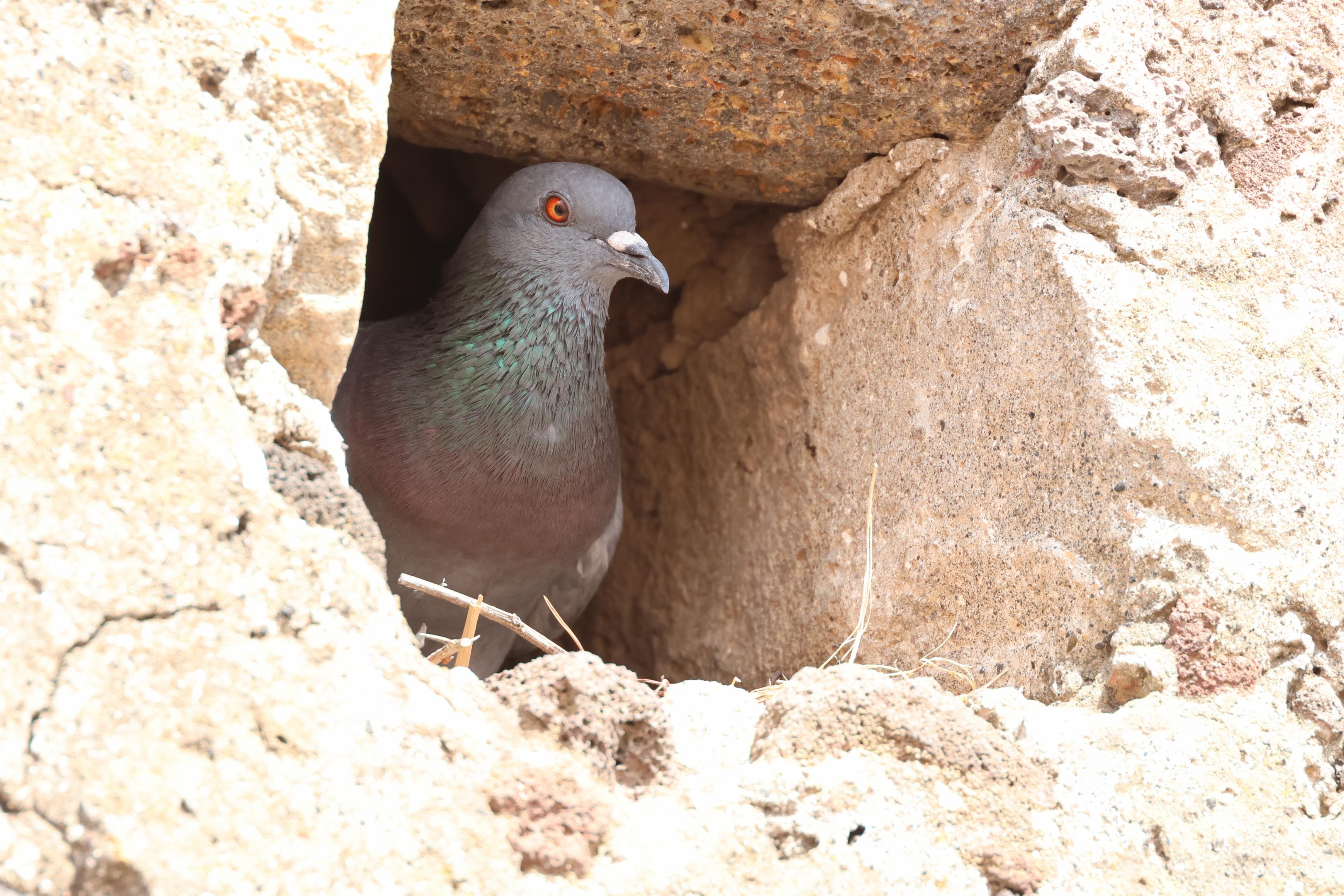
Rock dove with beautiful orange eyes. 2025-06-06 15:26:39 Stromboli
First observed in La Gomera on 2022-03-08.
Description
Geography: This bird appears across the great seas in the following continents: Europe, North America, South America, Africa, Asia.General: Deutschland: Brut-, Jahresvogel
Vocalization:
Not loud. [Link]
Seasonal behavior
Year-round bird Breeding: 01-01 - 12-31More details at Vogelwarte.ch
Other Details
Physical details
Physical details: length=31-34 cm, wingspan=63-70 cm, weight=230-370 gHabitats: Settlement
Vocalisation
Song: No details but a Xeno-Canto recording. Song:Song a two-syllable, but continuous cooing. First a rolling ascending "orrrrrr" immediately followed by a short descending "oohh". Wings produce a quite audible whistling sound. [Link]
Song attributes:
Frequency:
♫ Source: XENOCANTO XC661807 - Rock Dove call - Columba livia.mp3 (call)

No details but a Xeno-Canto recording.
Call attributes: song Frequency: ,
Details
Profile Wikipedia Vogelwarte BirdLife ZH ornitho.ch Audubon AllAboutBirds Xeno-Canto BirdID NABU YouTube

Wikipedia Datei Falco columbarius Male. Source: WIKIPEDIA
Wikipedia_Datei_Falco_columbarius_Male.jpg
First observed in 🇨🇭 on 2024-05-16.
Description
Geography: This bird appears across the great seas in the following continents: Europe, North America, South America, Africa, Asia.General:
The merlin (Falco columbarius) is a small species of falcon from the Northern Hemisphere,[2] with numerous subspecies throughout North America and Eurasia. A bird of prey, the merlin breeds in the northern Holarctic; some migrate to subtropical and northern tropical regions in winter. Males typically have wingspans of 53–58 centimetres (21–23 in), with females being slightly larger. They are swift fliers and skilled hunters which specialize in preying on small birds in the size range of sparrows to doves and medium-sized shorebirds. In recent decades merlin populations in North America have been significantly increasing, with some merlins becoming so well adapted to city life that they forgo migration; in Europe, populations increased up to about 2000 but have been steady subsequently.[3] The merlin has for centuries been well regarded as a falconry bird.
[more]
Deutschland: Zugvogel, Wintergast
Vocalization:
Series of harsh "kwik-wik wik". Coarseness similar to Peregrine, but pace much quicker. [Link]
Seasonal behavior
Year-round bird Migration in: 02-20 - 03-01 Migration out: 02-22 - 03-01More details at Vogelwarte.ch
Other Details
Physical details
Physical details: length=25-30 cm, wingspan=50-62 cm, weight=125-300 gHabitats: Agricultural Details
Profile Wikipedia Audubon AllAboutBirds Xeno-Canto BirdID NABU YouTube
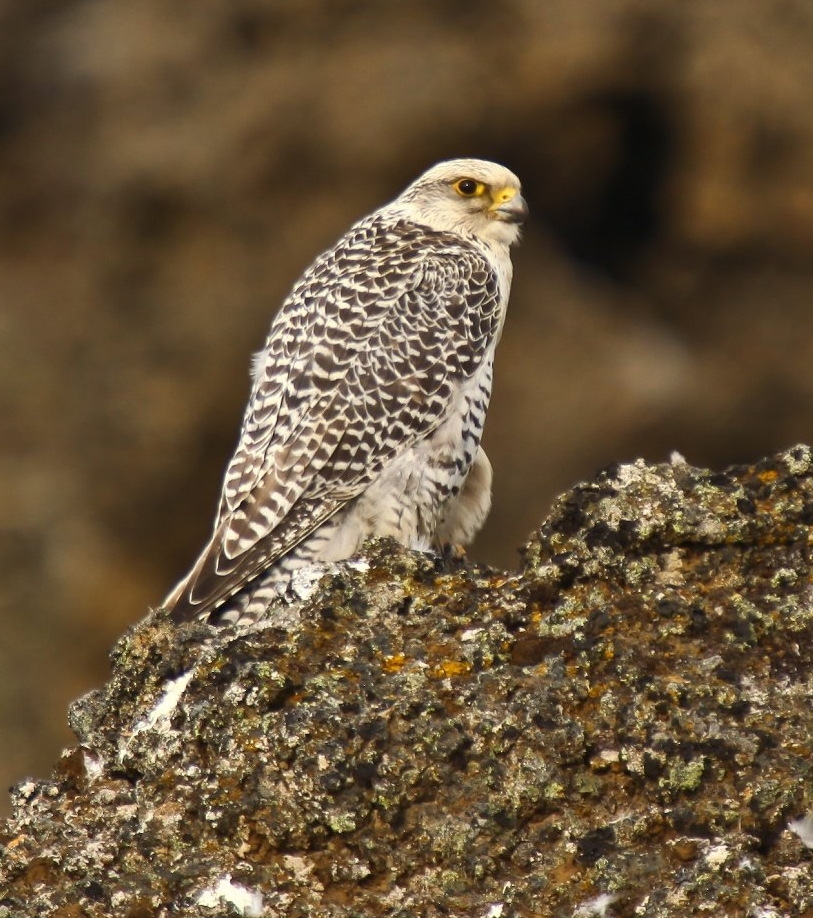
Wikipedia: Gyrfalcon Source: WIKIPEDIA
Falco_rusticolus_white_cropped.jpg
🔍
Never observed (yet!)
Description
Geography: This bird appears across the great seas in the following continents: Europe, North America.General:
Der Gerfalke (Falco rusticolus) ist die weltweit größte Falkenart. Er ist zirkumpolar in den arktischen Regionen Eurasiens und Nordamerikas sowie Grönlands vertreten und besiedelt dort die Tundra. In Mitteleuropa ist er nur sehr selten als Wintergast zu beobachten und hält sich dann meist in Küstennähe auf.
[more]
Vocalization:
A coarse, drawn out, Peregrine-like "kaaawt", with emphasis on ending, is repeated in series. Much slower paced than in small falcons, and deeper and with different attack than in Peregrine. [Link]
Other Details
Physical details
Physical details: length=50-60 cm, wingspan=130-160 cm, weight=805-2100 gDetails

Wikipedia: Red-throated loon Source: WIKIPEDIA
1200px-Gavia_Stellata_%C3%96lfus%C3%A1_20090606.jpg
🔍
Never observed (yet!)
Description
Geography: This bird appears across the great seas in the following continents: Europe, North America.General: Deutschland: Zugvogel, Wintergast
Vocalization:
In flight; nasal, dry, gooselike series of rhythmic cackling "ko-ko-ko". Most vocal when courting and breeding. A meowing drawn-out sound starting with a register break, then falling in pitch. [Link]
Seasonal behavior
Year-round bird Migration in: 02-01 - 02-10 Migration out: 02-02 - 02-10More details at Vogelwarte.ch
Other Details
Physical details
Physical details: length=53-69 cm, wingspan=106-116 cm, weight=1170-1900 gHabitats: River and lake Details

Great northern loon, Squam Lake, New Hampshire. 2023-10-06 12:26:58 New England
First observed in New England on 2023-10-06.
Description
Geography: This bird appears across the great seas in the following continents: Europe, North America.General: Deutschland: seltener Wintergast
Seasonal behavior
Seldom seen hereMore details at Vogelwarte.ch
Other Details
Physical details
Physical details: length=69-91 cm, wingspan=69-91 cm, weight=3600-4480 gDetails

Horned grebe, Myvatn, Iceland. 2015-06-05 11:22:28
First observed in Iceland on 2015-06-05.
Description
Geography: This bird appears across the great seas in the following continents: Europe, North America.General: Deutschland: Brut-, Zugvogel, Wintergast RL 1
Vocalization:
Varied. Vibrating, wailing, dry and cackling sequences. A mewing, falling and far-reaching "kiaa" and various rattling sounds. [Link]
Other Details
Physical details
Physical details: length=31-38 cm, wingspan=46-55 cm, weight=364-449 gHabitats: River and lake Details
Profile Wikipedia Audubon AllAboutBirds Xeno-Canto BirdID NABU YouTube
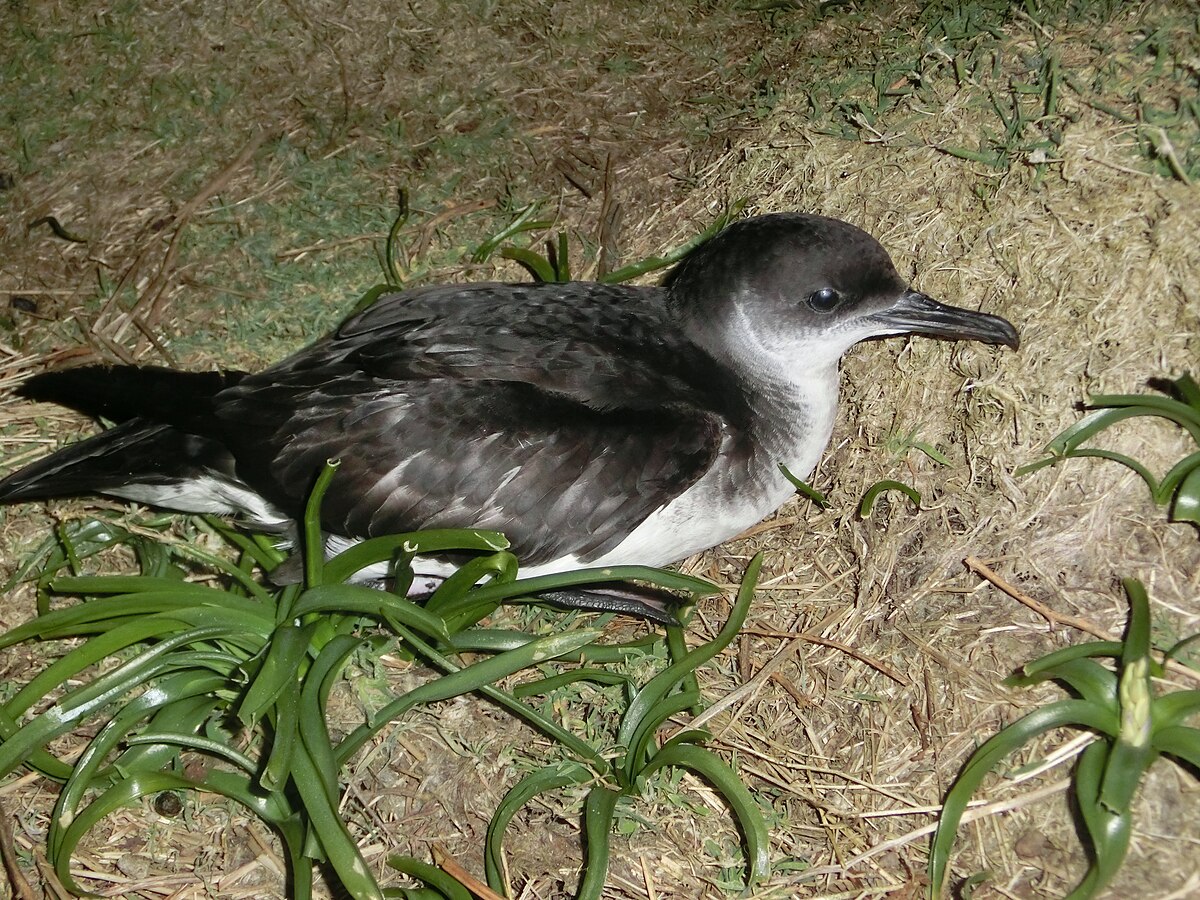
Wikipedia: Manx shearwater Source: WIKIPEDIA
1200px-Manx_Shearwater.JPG
🔍
Never observed (yet!)
Description
Geography: This bird appears across the great seas in the following continents: Europe, North America, Africa.General:
The Manx shearwater (Puffinus puffinus) is a medium-sized shearwater in the seabird family Procellariidae. The scientific name of this species records a name shift: Manx shearwaters were called Manks puffins in the 17th century. Puffin is an Anglo-Norman word (Middle English pophyn) for the cured carcasses of nestling shearwaters. The Atlantic puffin acquired the name much later, possibly because of its similar nesting habits.
[more]
Vocalization:
Vocal at breeding ground. [Link]
Other Details
Physical details
Physical details: length=31-36 cm, wingspan=76-88 cm, weight=375-459 gDetails

Wikipedia: Northern fulmar Source: WIKIPEDIA
Fulmarus_Glacialis.jpg
🔍
Never observed (yet!)
Description
Geography: This bird appears across the great seas in the following continents: Europe, North America, Asia.General: Deutschland: Brut-, Jahres-, Zugvogel, Wintergast RL R
Vocalization:
Mostly heard on breeding ground. [Link]
Other Details
Physical details
Physical details: length=45-50 cm, wingspan=102-112 cm, weight=610-1000 gDetails

Wikipedia: Leach's storm-petrel Source: WIKIPEDIA
1200px-Lesp1.jpg
🔍
Never observed (yet!)
Description
General: Deutschland: seltener ZugvogelOther Details
Physical details
Physical details: length=19-22 cm, wingspan=45-48 cm, weight=40-50 gDetails

Wikipedia: European storm-petrel Source: WIKIPEDIA
1200px-European_Storm_Petrel_From_The_Crossley_ID_Guide_Eastern_Birds.jpg
🔍
Never observed (yet!)
Description
General:Die Nördlichen Sturmschwalben (Hydrobatidae) sind eine auf allen Weltmeeren weit verbreitete Familie der Röhrennasen (Procellariiformes). Zur Familie gehören 15 Arten, die in der IOC-World Bird List zwei Gattungen zugeordnet werden[1], bei Winkler und Kollegen aber alle zur Gattung Hydrobates gehören.[2]
[more]
Vocalization:
Heard at breeding ground. Dry, cyclic, rattling and cooing, interrupted by deeper nasal moaning or a higher pitched "kee-ee-kee", with emphasis on second syllable. [Link]
Other Details
Physical details
Physical details: length=14-18 cm, wingspan=36-39 cm, weight=23-30 gDetails

Wikipedia: Short-eared owl Source: WIKIPEDIA
1200px-Short_Eared_Owl_on_the_Ground.jpg
🔍
Never observed (yet!)
Description
Geography: This bird appears across the great seas in the following continents: Europe, North America, South America, Africa, Asia.General: Deutschland: Brut-, Zugvogel, Wintergast RL 1
Other Details
Physical details
Physical details: length=37-39 cm, wingspan=95-110 cm, weight=260-420 gHabitats: Wetland Details
Profile Wikipedia Vogelwarte BirdLife ZH ornitho.ch bird-song.ch Audubon AllAboutBirds Xeno-Canto BirdID NABU YouTube
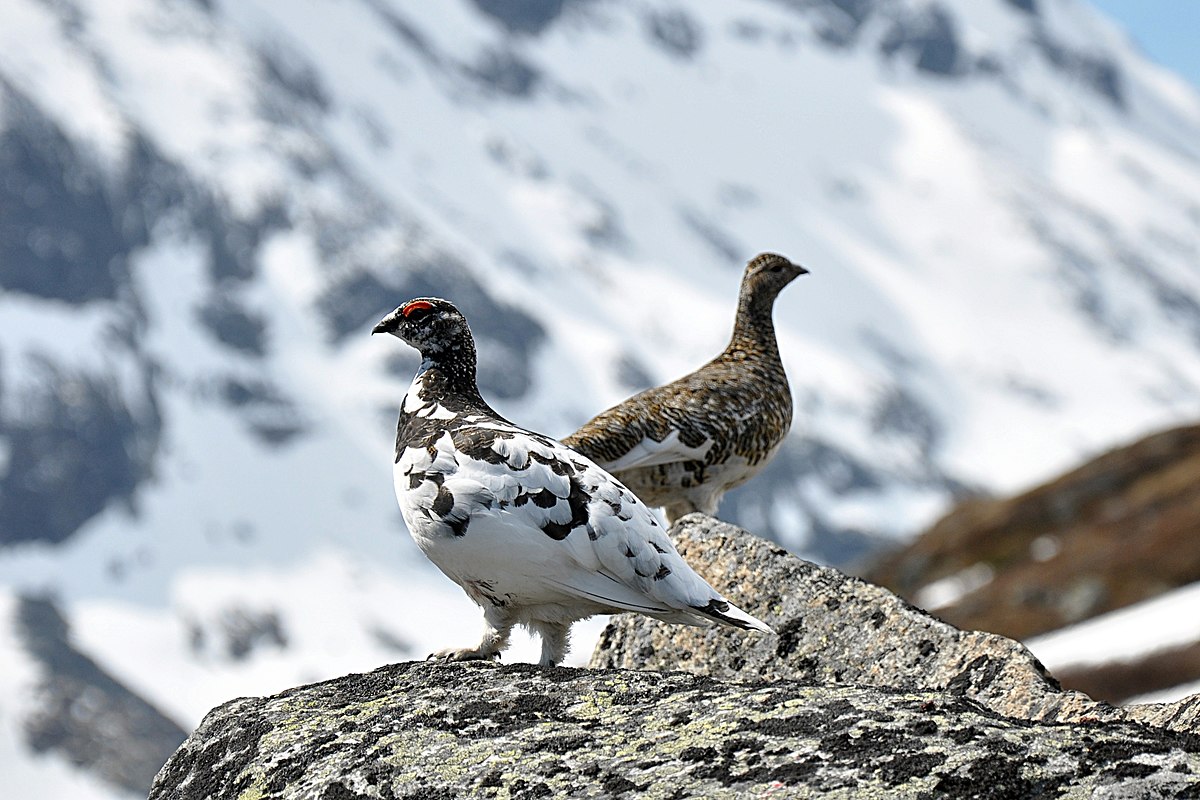
Wikipedia: Rock ptarmigan Source: WIKIPEDIA
1200px-Rock_Ptarmigan_%28Lagopus_Muta%29.jpg
🔍
Never observed (yet!)
Description
Geography: This bird appears across the great seas in the following continents: Europe, North America.General: Deutschland: Brut-, Jahresvogel RL R
Vocalization:
Female has similar sounds, but is higher pitched and not so coarse as male. [Link]
Seasonal behavior
Year-round bird Breeding: 05-01 - 08-09More details at Vogelwarte.ch
Other Details
Physical details
Physical details: length=34-36 cm, wingspan=54-60 cm, weight=350-600 gHabitats: Mountain Details